


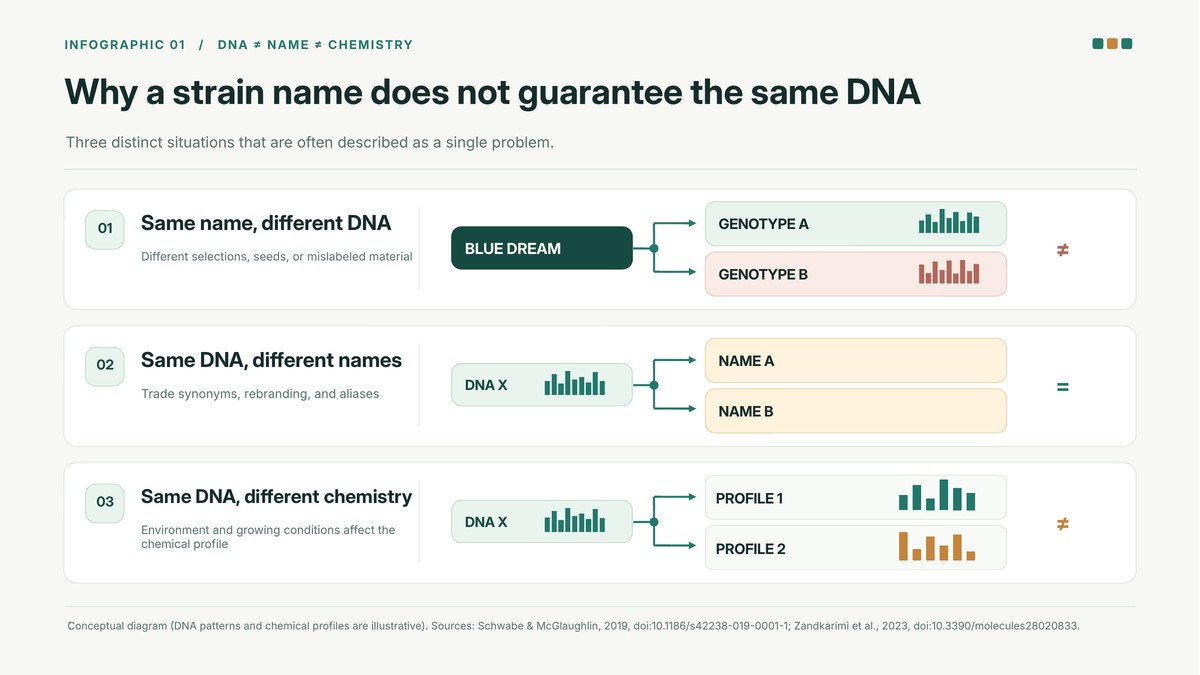
Cannabis strains with the same name can have different genetics because a strain name does not necessarily identify one unique, verified genotype. Differences can result from genetic segregation in seeds, independent breeding selections, different parental lines, mislabeled clones, or the commercial reuse of popular names.
This does not automatically mean a strain is counterfeit. Two plants may share legitimate ancestry while carrying different combinations of genes. Conversely, two products sold under an identical name may have little genetic resemblance.
Scientific studies have confirmed these inconsistencies in commercial cannabis. Understanding why they occur requires distinguishing three things that are often confused: a strain's name, its breeding lineage, and its actual DNA.
What Does a Cannabis Strain Name Really Tell You?
In the cannabis industry, the word strain is commonly used to describe a recognizable variety with particular characteristics, ancestry, aromas, or growth patterns. However, a commercial strain name is not necessarily a standardized genetic identifier.
The same name can describe:
- A specific clone: A selected plant preserved through vegetative propagation.
- A seed-based cultivar or breeding line: A population of related plants that may share a pedigree but are not genetically identical.
- A commercial product category: A familiar name applied to material whose exact genetic relationship to an original plant has not been established.
These distinctions determine how much genetic consistency should reasonably be expected.
| Cannabis identification | What it identifies | Expected genetic consistency |
|---|---|---|
| Commercial strain name | A name used by breeders or sellers | Variable; the name alone proves nothing |
| Declared pedigree | Parent plants or breeding ancestry | Related offspring, not necessarily identical DNA |
| Seed-based cultivar | A defined breeding population or line | Depends on stabilization and breeding method |
| Clone-only cultivar | A particular plant genotype reproduced vegetatively | Very high, assuming verified propagation |
| True F1 hybrid | First-generation offspring from appropriately stabilized parental lines | Potentially high uniformity |
| Chemovar or chemotype | A cannabinoid and other chemical profile | Does not establish genetic identity |
The distinction is particularly important for popular names such as Blue Dream, OG Kush, and Girl Scout Cookies. Their commercial recognition can persist even when different breeders develop genetically distinct versions.
For a closer explanation of inherited DNA versus observable characteristics, see Genotype vs. Phenotype in Cannabis: What's the Difference?.
Why Can Two Cannabis Strains With the Same Name Have Different DNA?
1. Seeds inherit different combinations of parental genes
Cannabis reproduces sexually through seeds. During meiosis, chromosomes recombine and genetic variants are distributed among offspring.
When two genetically heterozygous parents are crossed, their seeds can inherit different combinations of alleles.
For example, suppose a breeder crosses Plant A with Plant B and names the resulting line "Example Kush."
Even when every seed comes from the same two parents, individual plants may differ in:
- Plant architecture and development.
- Flowering characteristics.
- Cannabinoid production potential.
- Aromatic compound profiles.
- Responses to environmental conditions.
These differences can be normal consequences of sexual reproduction.
Sharing the same parents is not the same as sharing an identical genome.
2. Different breeders select different phenotypes
Phenotype selection is another major source of variation among cannabis strains carrying the same name.
Imagine two breeders obtaining seeds from the same original cross.
One selects plants emphasizing a particular aroma. The other selects individuals with different structural or developmental characteristics.
After further breeding, their resulting lines can become genetically distinct while retaining a recognizable original name.
This process may involve selfing (S1), backcrossing (BX), or selection over multiple generations.
The generation label describes breeding history, not guaranteed identity. For example, a BX3 plant may carry a larger expected genetic contribution from a recurrent parent than a BX1 plant, but that does not make it a clone of that parent.
Our guide to backcrossing in cannabis breeding explains how these generations work.
3. Different parental selections can share the same lineage name
A famous cannabis name does not always refer to one carefully documented parental pair.
The ancestry of historically popular strains was often passed between breeders informally. Original clones, closely related descendants, reconstructed crosses, and later selections could subsequently acquire similar labels.
Two breeders may therefore report the same broad pedigree while using different parental individuals.
Their resulting plants can have genuinely different DNA, even if both lineages reflect the same breeding tradition.
The problem is particularly relevant to older cannabis genetics, where historical documentation may be incomplete.
For readers interested in the preservation of original genetic resources, landrace cannabis strains provide another important perspective on ancestry and genetic diversity.
4. Clones can be mislabeled or redistributed under different names
Cloning generally preserves the genotype of the original mother plant.
However, the commercial distribution chain introduces opportunities for errors.
A cutting may pass through several suppliers before reaching its final destination. During this process, plant labels can be misplaced, confused, or replaced.
A popular name may also be deliberately reused for commercial reasons.
Therefore, two suppliers offering a supposedly identical clone-only strain may unknowingly or intentionally distribute different genetic material.
The reverse is possible, too: closely related or effectively identical clonal material can circulate under multiple names.
Neither situation can be resolved reliably from product names alone.
5. Even genuine clones can accumulate genetic changes
Clonal propagation is not a guarantee of absolute genetic immutability.
Somatic mutations can arise during cell division, and a single mother plant may contain genetically distinct cell populations, a phenomenon called genetic mosaicism.
Research by Adamek and colleagues (2024) identified increasing detectable genetic variation across successive subcultures of micropropagated cannabis.
However, these changes should not be confused with the much greater genetic differences that may separate unrelated plants.
A 2026 study by Lefebvre and colleagues, examining three cultivars over 60 weeks, also demonstrated that patterns of genetic and epigenetic change depend on the cultivar and propagation history.
In short, cloning offers a much stronger expectation of genetic identity than ordinary seed reproduction, but the biological and technical conditions still matter.

What Do Scientific Studies Reveal About Cannabis Strain Authenticity?
The 2015 study: identical names did not always mean related DNA
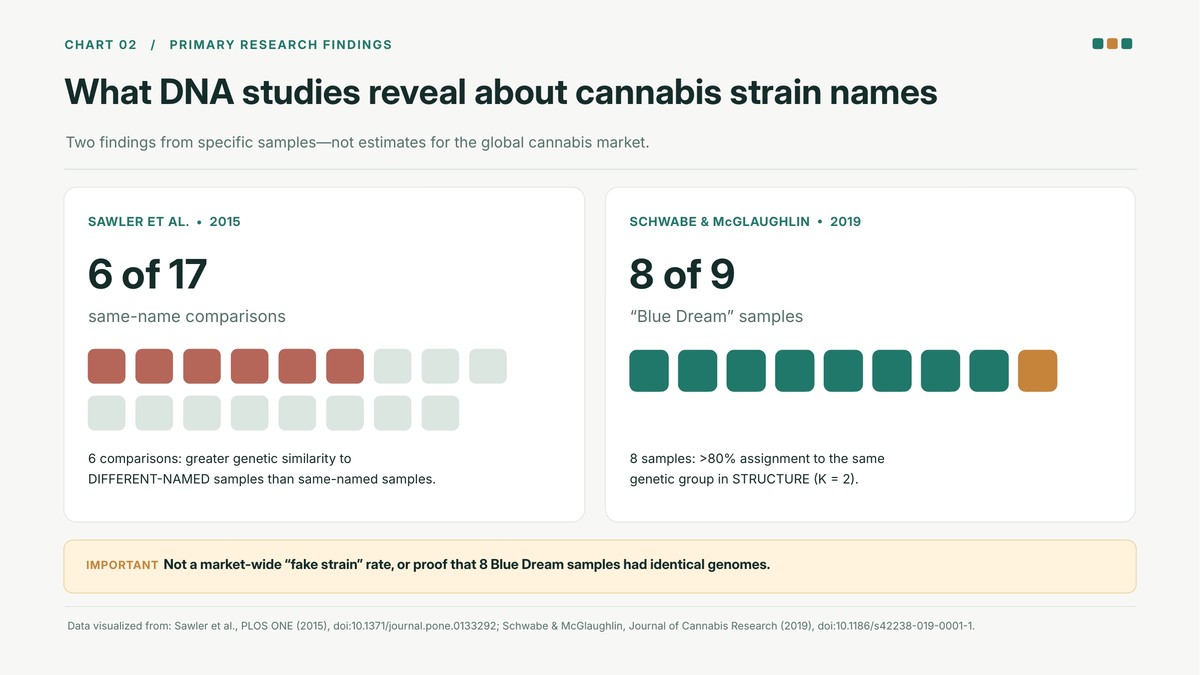
One of the foundational investigations was published by Sawler and colleagues in PLOS ONE in 2015.
The researchers compared genetic markers in hemp and marijuana samples, including plants marketed under identical strain names.
In 6 of 17 comparisons (approximately 35%), samples sharing a name were genetically more similar to samples with different names than to their namesakes.
This finding demonstrated that commercial cannabis names could be unreliable indicators of genetic identity.
However, it does not establish that 35% of all cannabis strains worldwide are fake. That percentage describes comparisons within a particular study, not a representative estimate of the global market.
The 2019 study: Blue Dream and Girl Scout Cookies
Schwabe and McGlaughlin expanded the investigation in 2019 by examining 122 cannabis samples representing 30 strain names from 20 sources across three US states.
They used ten microsatellite markers to evaluate genetic relationships.
Their findings included two particularly interesting examples.
Blue Dream: Eight of the nine samples showed considerable similarity in their genetic group assignments, while one stood out as genetically divergent.
Girl Scout Cookies: The eight samples bearing this name did not form an equally cohesive genetic group.
All eight groups described in industry sources as clone-only contained at least one genetically divergent sample.
Importantly, after obvious outliers were excluded, many strain groups demonstrated substantial consistency.
The researchers concluded that some familiar names corresponded to reasonably stable genetic groups, while others did not.
As Schwabe and McGlaughlin wrote in 2019:
"there is no way to verify the 'true' genotype of any strain."
This reflected the lack of a universally accepted reference and verification system at the time, not the impossibility of modern DNA testing.
The Blue Dream findings are especially instructive: most samples showed similarity, but one did not. The analysis did not establish which represented the historically original plant.
The Blue Dream strain category at GanjaFarmer.com also illustrates a related commercial distinction: photoperiod and autoflowering versions can share a recognizable strain name while having different declared breeding backgrounds.
Recommended seeds:


Marijuana Seeds: Why the Same Strain Name Does Not Guarantee Identical Genetics
Marijuana seeds deserve special attention because the relationship between seed identity and genetic uniformity is fundamentally different from that of clones.
A cannabis seed is a new genetic individual, not a direct DNA copy of its parents.
This principle applies whether a seed is marketed as regular, feminized, photoperiod, or autoflowering.
Regular and feminized cannabis seeds
Regular cannabis seeds typically allow for both male and female offspring and are useful in conventional breeding programs.
Feminized cannabis seeds are produced using methods designed to yield predominantly genetically female offspring.
However, feminization does not automatically eliminate genetic variation between seeds.
A packet of feminized seeds can contain genetically distinct siblings, just as a regular seed line can.
The degree of uniformity depends primarily on parental genetics, breeding history, and selection, not simply on whether the seeds are feminized.
Are F1 cannabis seeds genetically identical?
Not necessarily.
In formal plant breeding, a true F1 hybrid is produced by crossing appropriately stabilized parental lines. Such a cross can yield a highly uniform generation of heterozygous offspring.
By contrast, crossing two highly heterozygous cannabis plants also produces first-generation offspring in a chronological sense, but those offspring may show substantial genetic segregation.
This is why the term F1 requires context.
In their 2026 Trends in Genetics article, Anna L. Schwabe and Joshua S. Havill emphasized:
"Misuse of 'F1' terminology obscures expectations of uniformity."
Their observation highlights the difference between a generation label and a demonstrated level of uniformity.
Our detailed article on true F1 cannabis hybrids and heterosis explains the underlying breeding principles.
Readers can also explore the F1 hybrid seed category to compare how different products are described, while remembering that commercial labeling alone is not independent genetic verification.
Autoflowering versions of familiar strains
Autoflowering adaptations provide another straightforward example of why familiar strain names may represent different genetics.
When breeders introduce an autoflowering trait into a named photoperiod lineage through crossing and selection, the resulting product has an altered genetic background.
It may retain desirable characteristics associated with the original lineage without being genetically identical to the original clone or seed population.
Consequently, a photoperiod version and an autoflowering version of a strain should not automatically be treated as the same genotype.
At GanjaFarmer.com, comparing autoflowering seeds with photoperiod and regular varieties can help readers identify these distinctions in declared lineage and reproduction type.
For example, the following Girl Scout Cookies seed products represent different breeding formats under a related name. Their catalog descriptions illustrate differences in breeding history, not independently verified equivalence to a historical clone.
Recommended seeds:


Same Genetics, Different Aroma: Why DNA and Chemotypes Are Not the Same
A common misconception is that two cannabis plants must have different DNA if they smell different or contain different concentrations of cannabinoids.
In reality, a cannabis plant's chemical composition is influenced by both genetics and environmental conditions.
Genotype vs. chemotype
A genotype describes inherited genetic information.
A chemotype describes the chemical characteristics of a plant or product, such as cannabinoid composition. Broader chemical profiling may also include terpenes and other metabolites.
Genetically different cannabis plants can produce similar chemical profiles.
Conversely, genetically identical clones can develop different concentrations of metabolites under different environmental and physiological conditions.
Therefore, a laboratory certificate reporting THC, CBD, or terpene concentrations cannot independently establish that two samples originated from the same clone.
The genetic mechanisms behind major cannabinoid profiles are discussed in our article about THCA and CBDA synthase genes.
What nearly 90,000 commercial samples revealed
A 2022 study by Smith and colleagues analyzed chemical laboratory records from 89,923 cannabis samples across six US states.
Of these, 42,843 samples had usable terpene measurements.
The researchers identified repeatable chemical groupings, but commercial classifications did not consistently align with the observed chemical diversity.
Interestingly, some familiar names still carried meaningful chemical information.
For example, 88.5% of products labeled Blue Dream within the relevant analyzed subset belonged to one particular terpene cluster.
That is evidence of chemical consistency within this dataset, not proof that 88.5% of Blue Dream products were genetically authentic.
This distinction matters: a name can be statistically informative about chemistry without uniquely identifying DNA.
Can genetically different cannabis plants smell different?
Yes, and controlled sensory research has investigated this relationship.
In 2022, Schwabe and colleagues genotyped 32 cannabis samples and selected 15 for aroma evaluation by 55 participants.
Genetically divergent samples frequently received aroma descriptions that differed from the more genetically cohesive samples bearing the same strain name.
However, aroma alone cannot serve as definitive proof of genetic identity.
Terpenes, sulfur-containing compounds, post-harvest handling, storage, and other factors may influence the perceived smell.
Plant health can also matter. Hop latent viroid (HLVd), for example, can alter plant performance without necessarily indicating that the material belongs to a different genetic line.
For this reason, discrepancies in appearance, smell, or cannabinoid concentration should be investigated rather than automatically interpreted as evidence of different genetics.
Are Sativa and Indica Labels Reliable Indicators of Cannabis Genetics?
Commercial sativa, indica, and hybrid classifications do not consistently describe genome-wide relatedness in modern drug-type cannabis.
Watts and colleagues examined genetic and chemical data in a study published in Nature Plants in 2021.
Their final combined dataset included 137 samples and 116,296 single-nucleotide polymorphisms (SNPs).
The researchers reported that commercially sativa- and indica-labeled samples were not clearly separated on a genome-wide basis.
Instead, some labeling differences were associated with particular terpene concentrations and genetic variation near terpene synthase genes.
That does not mean every cannabis plant is genetically identical or that historical botanical distinctions are meaningless.
It means commercial sativa/indica labels should not be treated as definitive genetic classifications.
For buyers, chemical data, lineage documentation, and cultivar-specific evidence are more informative than a simple percentage describing presumed indica or sativa ancestry.
Can DNA Testing Prove Whether a Cannabis Strain Is Original?
DNA fingerprinting is among the most promising methods for verifying cannabis cultivar identity.
However, DNA testing can establish genetic similarity or difference more readily than historical authenticity.
If two samples have significantly different genetic profiles, a validated analysis may demonstrate that they are not the same clone.
But identifying which sample deserves a particular historical name requires reliable reference material and provenance documentation.
SSR markers, SNP panels, and whole-genome sequencing
Several approaches are used to compare cannabis DNA:
| DNA testing method | Main purpose | Important limitation |
|---|---|---|
| SSR or microsatellite markers | Compare genetic relationships using selected repeat regions | Limited genomic coverage |
| SNP fingerprinting | Distinguish samples using targeted DNA variants | Results depend on marker selection and validation |
| Genotyping-by-sequencing | Examine variation across many genomic regions | Requires substantial data processing and quality control |
| Whole-genome sequencing | Produce a comprehensive genomic comparison | More complex and resource-intensive; still requires sound reference data |
A small panel can be useful when it has been validated for the specific material and population being tested. More markers do not automatically guarantee a correct interpretation.
Why dried cannabis can complicate genetic identification
Cull and Joly (2025) developed a 20-SNP panel after sequencing 32 cannabis cultivars.
Their validation revealed an important technical limitation.
The proportion of assays failing to return a genotype was approximately 4.6% in the fresh-material validation tests, compared with 30.1% in commercial dried-flower tests.
The researchers also identified discrepancies between some assay results and sequencing-based expectations.
These findings illustrate why DNA fingerprinting requires careful quality control, suitable reference samples, and validated laboratory procedures.
A failed genotype call is not, by itself, evidence that two samples possess different DNA.
The most defensible conclusion from an authenticity test should therefore describe the degree of observed genetic similarity and the limitations of the method, rather than simply declaring a sample genuine or fake.
Do Official Cannabis Variety Registries Solve the Naming Problem?
Formal plant-variety systems exist, including European frameworks for variety registration, distinctness testing, and plant-variety rights.
The Community Plant Variety Office (CPVO) adopted technical protocol CPVO/TP-276/3 for Cannabis sativa L. in April 2026.
This protocol recognizes different biological and propagation categories and applies distinctness, uniformity, and stability (DUS) criteria appropriate to the plant material.
Importantly, official variety uniformity does not always require every plant to possess an identical genome.
Seed populations and clonally maintained cultivars are biologically different and must be evaluated accordingly.
Nor does the existence of official variety protection create a universal registry confirming every historical commercial marijuana strain name.
The distinction also appears in consumer-product regulations. Health Canada's cannabis packaging guidance lists the strain name as optional product information, subject to requirements against misleading labeling.
In 2026, Schwabe and Havill proposed a framework combining genetic fingerprinting with cultivar registration and verification. Such systems could improve traceability, but their proposal is not an implemented global standard.
Reliable cultivar identification ultimately requires more than regulatory terminology: it depends on genetic references, documentation, and the integrity of the material supply chain.
How to Evaluate Cannabis Seed Genetics and Strain Authenticity
For seed buyers, collectors, and breeders, the practical goal is not to assume that every seed with the same name must be genetically identical.
Instead, it is to establish what type of genetic consistency the producer is actually claiming.
Before evaluating a named cannabis variety, consider the following questions:
- Who developed or selected the genetics? Identify the breeder or source rather than relying exclusively on a familiar strain name.
- What is the declared pedigree? Check the parental lines and whether the product is an original selection, reconstruction, or subsequent cross.
- Is the material seed-based or clone-derived? These categories have fundamentally different expectations of genetic uniformity.
- What breeding generation is being sold? F1, F2, BX, S1, and other labels provide useful context but are not quality guarantees on their own.
- Is there documented consistency across batches? Look for meaningful breeding records, descriptions of tested traits, and appropriate traceability.
- What evidence supports authenticity claims? A cannabinoid certificate, a commercial name, and a DNA fingerprint answer different questions.
When evaluating several versions of a popular lineage, comparing declared genetics and breeding formats is more productive than assuming that the most recognizable name must indicate the original genotype.
No retailer's product listing, including those on a specialist seed website, should be mistaken for a formal DNA authentication certificate unless such verification is specifically documented.
Frequently Asked Questions About Cannabis Strain Genetics
Can two cannabis strains have the same name but completely different genetics?
Yes. The same commercial name can be applied to genetically distinct breeding lines, reconstructed crosses, or mislabeled material. However, studies showing different genetic profiles do not automatically prove that the plants are completely unrelated or that one is fraudulent.
Are cannabis seeds from the same pack genetically identical?
Not necessarily. Seeds produced by sexually reproducing parents can inherit different combinations of alleles. Highly uniform seed lines can reduce observable variation, but ordinary sibling seeds should not be assumed to possess identical genomes.
Are clones more genetically consistent than cannabis seeds?
Generally, yes. Clones produced from the same mother plant are expected to share an exceptionally similar genotype. However, labeling errors, somatic mutations, mosaicism, and propagation-related changes can complicate comparisons.
Does the same THC percentage mean two strains have the same genetics?
No. Different genotypes can produce similar THC concentrations or broader chemical profiles. THC content is not a reliable genetic fingerprint.
Can DNA testing identify the original OG Kush or Blue Dream?
It can compare genetic profiles and assess relationships between samples. However, confirming which represents the historical original requires authenticated reference material, suitable genetic testing, and documented provenance.
Without those elements, the test may reveal differences without establishing which sample has the strongest claim to the original name.
Conclusion: Cannabis Strain Identity Is More Than a Name
Cannabis strains with the same name can have different genetics for legitimate biological reasons, including seed recombination, independent selection, and different breeding generations. Commercial relabeling, undocumented ancestry, and distribution errors introduce additional uncertainty.
Scientific research has repeatedly demonstrated that familiar strain names are not universal genetic identifiers.
Yet the findings also show that some named cultivars display meaningful genetic or chemical consistency.
The key is to distinguish a verified clone, a documented seed line, and a broader commercial designation.
A strain name tells you what a product is called. Its pedigree explains where it is said to come from. Its DNA provides evidence about what it actually is.
For anyone interested in cannabis genetics, that distinction is the foundation of informed evaluation.
Bibliography
- Sawler, J., et al. (2015). The Genetic Structure of Marijuana and Hemp. PLOS ONE, 10(8), e0133292.
- Schwabe, A. L., & McGlaughlin, M. E. (2019). Genetic tools weed out misconceptions of strain reliability in Cannabis sativa: implications for a budding industry. Journal of Cannabis Research, 1, 3.
- Watts, S., et al. (2021). Cannabis labelling is associated with genetic variation in terpene synthase genes. Nature Plants, 7, 1330–1334.
- Smith, C. J., Vergara, D., Keegan, B., & Jikomes, N. (2022). The phytochemical diversity of commercial Cannabis in the United States. PLOS ONE, 17(5), e0267498.
- Schwabe, A. L., Naibauer, S. K., McGlaughlin, M. E., & Gilbert, A. N. (2022). Human olfactory discrimination of genetic variation within Cannabis strains. Frontiers in Psychology, 13, 942694.
- Adamek, K., Jones, A. M. P., & Torkamaneh, D. (2024). Somatic Mutation Accumulations in Micropropagated Cannabis Are Proportional to the Number of Subcultures. Plants, 13(14), 1910.
- Cull, A., & Joly, D. L. (2025). Development and validation of a minimal SNP genotyping panel for the differentiation of Cannabis sativa cultivars. BMC Genomics, 26, 83.
- Lynch, R. C., et al. (2025). Domesticated cannabinoid synthases amid a wild mosaic cannabis pangenome. Nature.
- Lefebvre, V., et al. (2026). Micropropagation of Cannabis sativa: genetic and epigenetic stability assessment over multiple generations. Journal of Cannabis Research, 8, 43.
- Schwabe, A. L., & Havill, J. S. (2026). A proposed framework for genetic verification and cultivar protection in cannabis. Trends in Genetics, 42(5), 396–399.
- Community Plant Variety Office (2026). CPVO/TP-276/3: Cannabis sativa L. Technical Protocol for Distinctness, Uniformity and Stability Testing.
- Health Canada. Packaging and Labelling Guide for Cannabis Products. Government of Canada.
 USA
 Česko
 Deutschland
 España
 France
 Italia
 Nederland
 Polska
 Europe