

Indica, sativa, and hybrid labels describe broad categories of cannabis, but they cannot reliably predict how a particular strain will affect you. These terms may offer clues about a plant's ancestry, growth characteristics, or traditional aroma profile. However, they do not consistently identify its genetic composition, THC or CBD content, or psychoactive effects.
The familiar rule that indica is relaxing, sativa is energizing, and hybrids fall somewhere in between is an oversimplification. Modern cannabis genetics are considerably more complex, and decades of crossbreeding have blurred the boundaries between these traditional categories.
A systematic review published in October 2026, covering 28 empirical studies, concluded that indica, sativa, and hybrid labels are not reliable guides to cannabis chemistry or therapeutic effects (Zoobi et al., 2026).
So, are these labels meaningless? Not entirely. Understanding what they describe—and what they leave out—can help you make better sense of cannabis strains, seed genetics, and laboratory testing.
Indica vs. Sativa vs. Hybrid: Key Differences at a Glance
The following comparison separates traditional descriptions from conclusions supported by contemporary research.
| Feature | Indica | Sativa | Hybrid |
|---|---|---|---|
| Traditional plant appearance | Shorter, bushier, broader leaves | Taller, more elongated, narrower leaves | Variable characteristics inherited from parent plants |
| Commonly advertised effects | Relaxation, sedation, physical heaviness | Energy, alertness, creativity | Balanced or parent-dependent effects |
| Typical historical associations | Broad-leaf drug-type populations, including Afghan lineages | Narrow-leaf populations and other historically described lineages | Crosses involving different genetic backgrounds |
| Aroma associations | Often earthy, musky, or woody | Often fruity, citrusy, or herbal | Highly variable |
| Genetic identity | Not a universally defined commercial DNA category | Not a universally defined commercial DNA category | Indicates crossing, but not a standardized ancestry percentage |
| Predicts THC potency? | No | No | No |
| Reliably predicts effects? | No | No | No |
| Most useful interpretation | A clue about breeding history or traditionally associated traits | A clue about breeding history or traditionally associated traits | A broad description of mixed ancestry or breeding |
These are tendencies and marketing conventions, not biological rules. A sativa-labelled plant can develop a relatively compact structure, while an indica-labelled product can have a cannabinoid and terpene profile that overlaps with products sold as sativa.
More importantly, plant appearance and the effects of the finished product are different questions. One cannot reliably establish the other.
Where Did the Indica and Sativa Labels Come From?
Botanical names and modern strain labels are not the same thing
The terms indica and sativa have legitimate botanical histories.
In 1753, Carl Linnaeus formally described Cannabis sativa L. In 1785, Jean-Baptiste Lamarck described Cannabis indica, based on plants displaying characteristics that differed from those familiar to European botanists.
Over subsequent centuries, taxonomists disagreed over whether cannabis should be classified as one species, several species, or a collection of subspecies and varieties.
The history becomes particularly complicated because the original botanical concept of Cannabis indica does not correspond neatly to the broad-leaf, compact Afghan-type plant that many contemporary seed catalogs call indica.
Different regional populations evolved or were selected for different characteristics. These differences are biologically important, even though today's commercial naming system does not accurately reconstruct them.
Traditional regional populations, commonly called landraces, remain valuable for understanding cannabis ancestry and preserving genetic diversity. Our article on landrace cannabis strains and original genetics explores this subject in greater depth.
What does 70% indica or 60% sativa actually mean?
A strain described as 70% indica and 30% sativa is not necessarily carrying a scientifically measured 70% share of identifiable indica DNA.
Such percentages may be based on breeding records, the characteristics of parental plants, or a breeder's classification system.
There is no universally adopted genomic test that assigns every modern cannabis cultivar a definitive indica-to-sativa percentage.
This distinction matters because inheritance is not an arithmetic average of every visible or chemical trait.
A hybrid may inherit compact growth from one parent, a distinctive aroma from another, and a cannabinoid profile shaped by several genes.
Likewise, a commercial hybrid is not automatically a genetically uniform F1 hybrid. True F1 breeding involves a more specific process using selected parental lines. For further context, see how true F1 cannabis hybrids achieve vigor and uniformity.
What Does Cannabis Genetics Really Say About Indica and Sativa?
One of the strongest challenges to traditional cannabis classification comes from genome-wide research.
In a 2021 study published in Nature Plants, Watts and colleagues compared commercial cannabis labels with genetic and chemical data.
The researchers analyzed 297 chemically characterized samples, including 137 samples with suitable genetic data, examining 116,296 genetic markers.
They found no clear genome-wide separation between samples labelled indica and those labelled sativa.
The first ten principal components of genomic variation explained only 37% of the variation in the reported indica–sativa classification.
Importantly, that figure does not mean that 37% of strain labels were correct. It describes how much of the variation in the commercial labelling scale could be explained statistically by the genetic model.
The labels still capture some biological information
The same study found correlations between certain labels and genes involved in terpene production.
Indica-labelled samples were associated with higher concentrations of some compounds, particularly myrcene. Sativa-labelled samples showed associations with compounds including farnesene and bergamotene.
These results suggest that parts of the traditional classification may reflect inherited aromatic characteristics.
However, these associations were neither universal nor sufficient to predict the complete chemical composition of an individual product.
The broader genetic picture is therefore nuanced: cannabis populations are genetically diverse, but commercial indica and sativa labels do not accurately represent that diversity.
Plant geneticist Dr. Sean Myles, a co-author of the 2021 study, emphasized that consumers should not rely on these labels to determine what they are consuming.
The difference between inherited genetic potential and observable plant characteristics is also central to understanding why a single strain can show variation. Learn more in our guide to genotype vs. phenotype in cannabis.
Explore two examples of traditional seed classifications: Afghan Auto is described as indica, while Blue Dream Auto is marketed as sativa-dominant. These are examples of how seed catalogs communicate genetic characteristics, not guarantees of particular effects.
Recommended seeds:

Cannabinoids, Terpenes, and Chemovars: What Matters More Than the Label?
If indica, sativa, and hybrid labels cannot reliably describe a finished cannabis product, what information should take priority?
The answer starts with measurable chemistry.
THC, CBD, and cannabinoid chemotypes
Cannabinoids are among the most important compounds for understanding cannabis pharmacology.
THC (tetrahydrocannabinol) is primarily responsible for cannabis intoxication, while CBD (cannabidiol) has a different pharmacological profile and does not produce the characteristic THC high.
Researchers frequently distinguish cannabis chemotypes according to the relative abundance of these cannabinoids.
| Chemotype | Main characteristic | What it tells you |
|---|---|---|
| Type I | THC-dominant | The material predominantly produces THC-related cannabinoids |
| Type II | Mixed THC/CBD | Both THC- and CBD-related cannabinoids are important components |
| Type III | CBD-dominant | CBD-related cannabinoids predominate over THC-related cannabinoids |
Additional chemotypes are described in scientific literature, including those involving other cannabinoid pathways.
This classification is more chemically meaningful than indica versus sativa because it concerns measurable biochemical characteristics.
For example, an indica-labelled strain and a sativa-labelled strain may both be THC-dominant. Conversely, two varieties sharing the same commercial classification may have substantially different THC ratios.
Even this distinction requires care. Cannabis plants predominantly produce acidic cannabinoid precursors such as THCA and CBDA, which can convert into THC and CBD through decarboxylation.
The genes responsible for synthesizing these precursors help explain why different genetic lines develop different cannabinoid profiles. Our article on THCA and CBDA synthase genes explains the underlying biology.
Can terpenes predict indica or sativa effects?
Terpenes are aromatic compounds found throughout the plant kingdom. In cannabis, they contribute to recognizable herbal, fruity, woody, citrus, and spicy aromas.
Common examples include:
| Terpene | Common aroma associations | Important limitation |
|---|---|---|
| Myrcene | Earthy, musky, herbal | Not a clinically validated predictor of sedation |
| Limonene | Citrus, lemon, orange | Citrus aroma does not establish an energizing effect |
| β-Caryophyllene | Peppery, spicy, woody | Receptor-related research does not establish a predictable clinical outcome |
| Pinene | Pine, resinous, fresh | Not a reliable indicator of increased alertness |
| Terpinolene | Herbal, woody, fresh | Its association with some sativa labels does not establish a specific psychoactive effect |
Terpenes offer a more detailed description of chemical composition than the indica–sativa distinction, but their presence is not sufficient to predict how a product will affect an individual.
Research findings can also differ between sample populations.
In a 2016 chemical study, Hazekamp and colleagues observed an association between myrcene and indica classifications that differed from findings reported in earlier research.
Their conclusion was appropriately cautious:
"These conflicting results indicate that selecting single compounds as markers for specific cannabis types may have its limitations."
— Hazekamp, Tejkalová, and Papadimitriou, 2016.
The evidence supports studying complete chemical profiles rather than treating one terpene as a definitive indicator of a particular cannabis type.
The entourage effect: promising research, not a proven shortcut
The proposed entourage effect concerns interactions between different constituents of cannabis.
It is sometimes presented as an explanation for why two products with similar THC content might produce different experiences.
However, laboratory findings have not been consistent across experimental models.
Finlay and colleagues (2020) did not observe the proposed cannabinoid-receptor modulation by selected terpenoids in their experiments.
More recently, Raz and colleagues (2026) reported additive and synergistic interactions between certain terpenes and THC at CB1 and CB2 receptors in an experimental receptor system.
These findings are not necessarily contradictory: the studies used different methods and measured different aspects of receptor activity.
Crucially, molecular interactions do not automatically translate into reliable predictions about relaxation, alertness, pain relief, or other outcomes in humans.
A terpene profile can therefore be useful without being a clinically validated effects guide.
Cannabis aroma is not just about terpenes
Another often-overlooked finding concerns the chemistry of cannabis aroma.
Research by Oswald and colleagues (2023) identified minor volatile compounds, including sulfur-containing substances and skatole, that can contribute substantially to distinctive aromas.
Some of these compounds occur in very low concentrations but have a strong sensory impact.
Consequently, even a comprehensive list of major terpenes may not completely explain how a particular cannabis product smells.
This is another reason not to treat a simple aroma description as a substitute for chemical characterization.
What Large-Scale Cannabis Testing Reveals About Strain Names
Research involving tens of thousands of samples offers a clearer picture of how commercial cannabis labels relate to actual chemical composition.
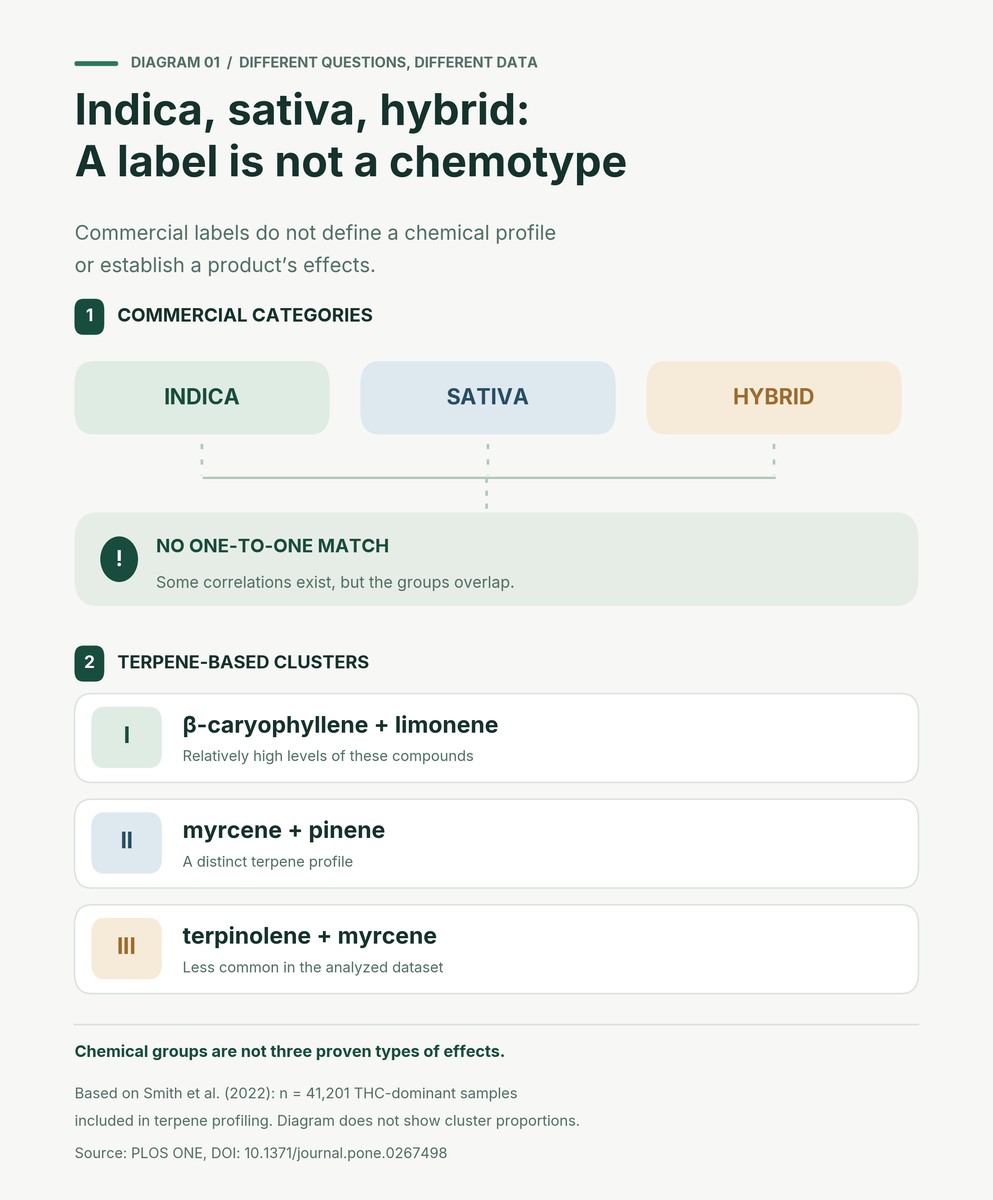
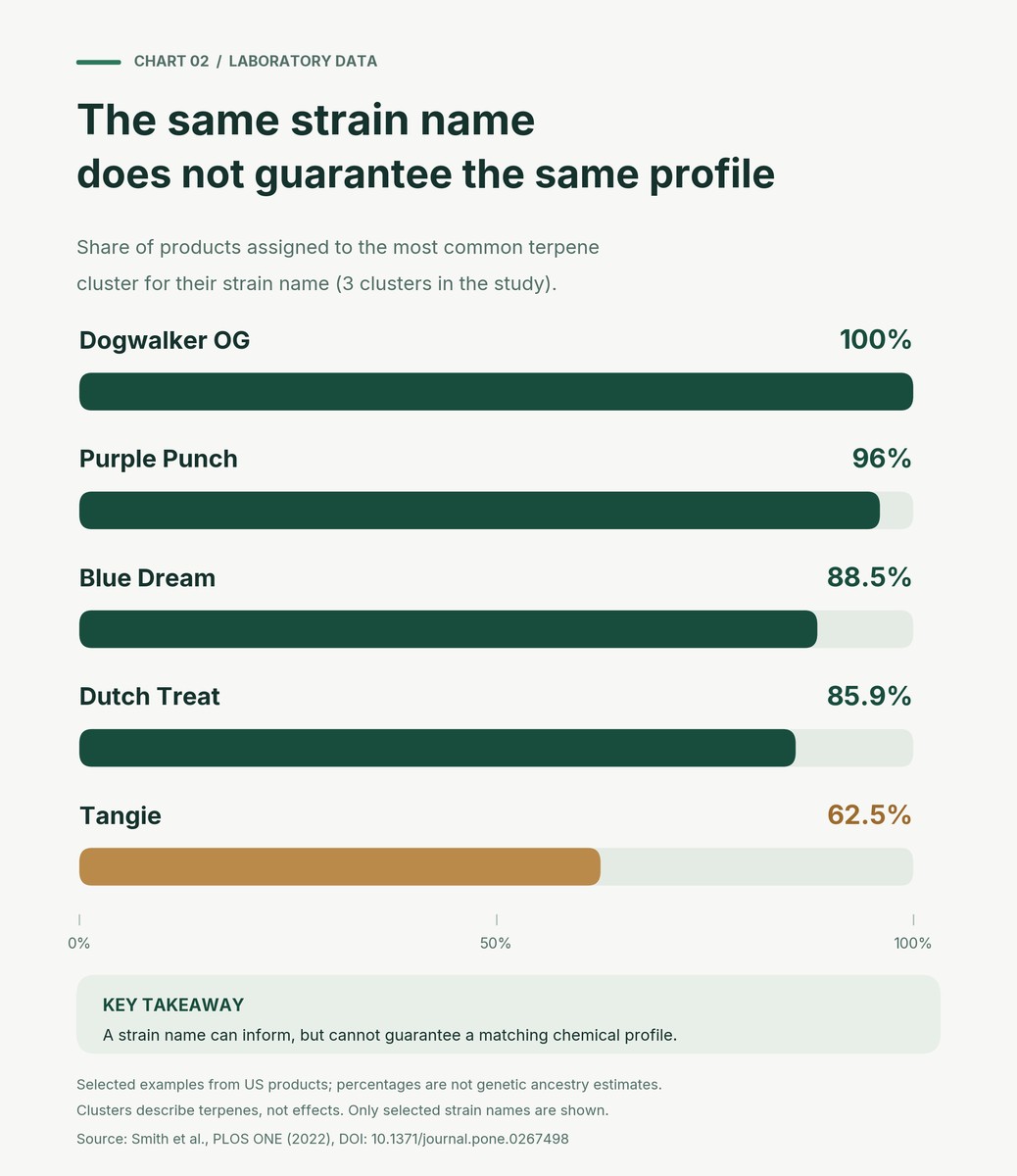
In 2022, Smith and colleagues analyzed 89,923 commercial cannabis samples collected through testing laboratories in six US states.
Of these, 42,843 had terpene measurements available.
Their analysis identified three major groups characterized by relatively higher concentrations of particular terpenes:
- Caryophyllene and limonene.
- Myrcene and pinene.
- Terpinolene and myrcene.
These groups described chemical similarity more effectively than the familiar indica, sativa, and hybrid categories.
However, they were not three scientifically established categories of psychoactive effects.
A separate 2025 study by Herwig and colleagues examined 140 medicinal cannabis flower products available in Germany and identified six terpene-based groups.
Why three in one study and six in another?
The results depend on the samples analyzed, the chemical compounds measured, the statistical techniques applied, and the criteria used for defining groups.
A chemical classification can be valuable without becoming a new universal cannabis taxonomy.
Is the strain name more reliable than indica or sativa?
Sometimes—but the answer varies considerably.
Smith and colleagues found that 96% of product averages associated with the name Purple Punch belonged to one major terpene cluster.
For Tangie, only 62.5% belonged to its most common cluster.
This does not prove that every Purple Punch product has identical genetics or that Tangie is inherently inconsistent.
It shows that commercial strain names can differ significantly in their chemical consistency within a particular dataset.
The same name may also be used by different producers, and products sold under that name may not have identical genetic origins.
The practical lesson is that a recognizable strain name is a starting point for identification, not a guarantee of standardized chemistry.
Indica vs. Sativa Effects: Does Indica Really Relax You and Sativa Energize You?
The traditional effects comparison remains popular because it is simple and memorable.
Indica is associated with physical relaxation and sleepiness, while sativa is described as uplifting, stimulating, or creativity-enhancing.
But controlled scientific evidence does not support using these labels alone to predict individual responses.
In a 2023 observational study involving 101 regular cannabis users, Okey and colleagues found an association between indica classifications and certain low-arousal subjective effects.
This is an interesting result, and it should not be dismissed.
However, an observational association does not establish that belonging to a distinct biological indica category causes sedation.
Differences may also reflect THC exposure, individual preferences, previous experience, product selection, consumption patterns, or expectations.
The October 2026 systematic review by Zoobi and colleagues similarly found inconsistent relationships between commercial labels and human outcomes.
Could the label itself influence your experience?
Potentially.
Someone expecting an indica product to be relaxing may interpret sensations differently from someone expecting a sativa product to be stimulating.
This phenomenon is known as an expectancy effect.
It does not mean that cannabis experiences are imaginary. Rather, expectations can influence subjective assessments alongside genuine pharmacological effects.
An experimental study registered by Johns Hopkins University (NCT07214155) is designed to investigate this distinction by comparing cannabis products labelled indica, sativa, or generically under controlled conditions.
As of October 26, 2026, the trial had no published results.
What should matter when considering cannabis effects?
A more informative assessment includes measured cannabinoid content, actual exposure, product formulation, administration route, personal sensitivity, previous experience, and relevant safety considerations.
For medical purposes, decisions should be guided by appropriate clinical assessment and standardized product information rather than strain marketing.
The essential distinction is between what scientists can measure in a sample and what they can reliably predict about an individual's response.
What Do Indica, Sativa, and Hybrid Labels Mean for Marijuana Seeds?
Cannabis seed classification raises a different set of questions from the classification of finished cannabis flower.
A seed contains genetic information that influences the future plant's potential characteristics. It does not provide a direct laboratory measurement of the chemical composition that a mature plant will eventually produce.
For readers exploring marijuana seeds, traditional indica, sativa, and hybrid classifications may still help organize a breeder's catalog. They can indicate broad lineage, historically associated morphology, and the kinds of characteristics targeted during selection.
However, these labels do not guarantee a particular plant height, cannabinoid concentration, aroma, or psychoactive effect. Such characteristics depend on genetic inheritance and, in the case of expressed plant traits, interactions with environmental conditions.
The more useful seed descriptions explain parentage, expected plant structure, flowering characteristics, and the degree of genetic stability or uniformity that the breeder can substantiate.
For example, autoflowering describes a genetically influenced flowering behavior that does not require the photoperiod change typically used to initiate flowering in photoperiod-sensitive varieties. Feminized describes seeds produced to yield predominantly female plants. Neither term indicates whether the resulting cannabis will have a particular psychoactive effect.
At GanjaFarmer.com, enthusiasts can compare indica cannabis seeds, sativa cannabis seeds, and modern hybrids while examining additional details beyond the traditional labels. The catalog also distinguishes feminized seeds, autoflowering genetics, and F1 hybrid seeds, making it easier to consider different aspects of plant genetics separately.
For collectors and breeders, this broader approach is more informative than choosing a seed solely because it carries a particular indica or sativa percentage.
Remember that laws governing cannabis seed possession, germination, and cultivation differ between jurisdictions. Always check the applicable rules.
Explore two modern hybrid examples: Cereal Milk is cataloged as a 50/50 hybrid, while Bruce Banner is described as a 40/60 indica–sativa hybrid. These ratios communicate breeder classifications rather than independently verified proportions of the genome.
Recommended seeds:


How to Evaluate Cannabis Strains More Accurately
Moving beyond traditional categories does not require abandoning familiar strain names. It means understanding how to interpret the available information.
1. Check the genetics and breeder information
For seeds, examine the stated parental lines and the characteristics the breeder has selected for.
A documented lineage gives more meaningful context than a generalized indica or sativa percentage, although pedigree information itself is not proof of genetic identity.
Where available, information about breeding stability and uniformity can also be useful.
2. Look for measured cannabinoid content
When evaluating finished cannabis products, tested THC and CBD concentrations are more informative than broad effects labels.
A high-THC sativa is not automatically less intoxicating than a high-THC indica.
Likewise, the word hybrid does not indicate an intermediate potency level.
It is important to distinguish between a breeder's estimated cannabinoid range for a cultivar and analytical results obtained from an actual flower sample.
3. Understand what a certificate of analysis confirms
A certificate of analysis (COA) provides results for the tested sample, often identified by a batch or lot number.
Depending on the testing panel, it may report cannabinoids, terpenes, microbial contamination, pesticides, or other quality-related measurements.
However, a cannabinoid analysis does not automatically confirm that a product has been tested for every relevant contaminant.
The date, sample identity, test method, and reported analytes matter.
A COA also describes the material tested at a particular time. It does not guarantee that every later batch, or even an inadequately stored sample from the same batch, will have an identical chemical profile.
4. Consider the difference between genetics and the finished product
Genotype contributes to a plant's chemical potential, but environmental conditions and post-harvest processing can affect its observable characteristics.
Differences in production, drying, storage, and decontamination may change the composition of volatile compounds.
Thus, even genetically related plants can produce products with distinguishable laboratory profiles.
The relationship between genetics and chemistry is real, but not mechanically identical across every production environment.
5. Avoid translating chemical data directly into medical promises
Chemical information is valuable for quality control and research, but identifying compounds does not prove a specific therapeutic benefit.
An elevated myrcene concentration, for instance, is not sufficient evidence that a product will treat insomnia.
Similarly, a limonene-rich profile does not establish that it will improve concentration.
For patients, clinical evidence, product standardization, safety considerations, and professional guidance remain essential.
Why Medical Cannabis Standards Focus on Chemistry, Not Indica and Sativa
The distinction between marketing labels and scientifically measurable characteristics is particularly clear in pharmaceutical standards.
The European Pharmacopoeia's Cannabis flower monograph (3028), implemented in July 2024, classifies medicinal cannabis flower according to cannabinoid content, including THC-dominant, intermediate THC/CBD, and CBD-dominant types.
The specification concerns botanical identity, chemical content, and pharmaceutical quality—not the familiar indica, sativa, and hybrid marketing categories.
Polish regulatory guidance issued in 2019 similarly required medicinal cannabis raw materials to be named using Cannabis flos and declared THC/CBD content, rather than relying on fanciful commercial strain names.
These standards do not imply that cannabinoid measurements fully predict every therapeutic outcome.
They demonstrate a more fundamental principle: a scientifically defensible product specification must rely on defined, measurable characteristics.
That principle is useful well beyond medical cannabis.
Frequently Asked Questions About Indica, Sativa, and Hybrid Strains
Is indica stronger than sativa?
No. Neither classification reliably indicates THC potency. Both indica-labelled and sativa-labelled products can have high or low cannabinoid concentrations. Strength and effects depend on the actual product chemistry, exposure, and individual response.
Is sativa always energizing?
No. The association between sativa and stimulation is a traditional consumer description rather than a dependable pharmacological rule. Sativa-labelled products can produce different subjective experiences, and the label alone does not establish an energizing effect.
Do indica strains always make you sleepy?
No. Some observational research has found associations between indica labels and lower-arousal effects, but those findings do not establish a universal causal relationship. The presence of a particular terpene is also not sufficient to predict sedation.
Are hybrid cannabis strains always 50% indica and 50% sativa?
No. Hybrid simply refers to a plant produced through crossing different parental genetic lines. Commercial hybrids may be described as indica-dominant, sativa-dominant, or balanced, but the percentages are not necessarily determined by standardized genomic testing.
Are terpene profiles more reliable than indica and sativa labels?
They are more informative for describing measured chemical composition and aspects of aroma. However, current evidence does not justify treating individual terpenes or terpene combinations as reliable predictors of specific therapeutic or psychoactive effects in humans.
Do indica and sativa labels matter when choosing cannabis seeds?
They can provide useful background about a strain's breeding history and traditionally associated plant traits. However, documented parentage, seed type, genetic stability, and cultivar-specific characteristics are more useful for understanding the material than the broad indica–sativa label alone.
The Bottom Line: Useful Labels, Limited Predictions
Indica, sativa, and hybrid are not completely meaningless terms. They preserve elements of botanical history, breeding traditions, plant morphology, and commercial classification.
What they do not provide is a scientifically reliable system for predicting the chemical composition or effects of an individual cannabis product.
Genetics helps explain ancestry and inherited potential. Laboratory chemistry describes measurable compounds. Clinical research investigates how standardized products affect people.
These are related but distinct levels of evidence.
For cannabis seed enthusiasts, the most useful approach is to treat indica, sativa, and hybrid as introductory categories and then examine the actual genetic and breeding information behind each variety.
For finished cannabis products, tested cannabinoid content, batch identity, comprehensive quality information, and appropriate safety considerations provide a stronger foundation.
The most important question is no longer simply whether a strain is indica, sativa, or hybrid. It is what can actually be verified about that particular genetic line or product—and what remains uncertain.
Scientific References and Further Reading
- Zoobi, G., Marco, M., Foraida, K. J., Tandon, S., & Zhornitsky, S. (2026). Do consumer-facing “Indica,” “Sativa,” and “Hybrid” labels predict cannabis composition or effects? A systematic review. Journal of Cannabis Research.
- Watts, S., McElroy, M., Migicovsky, Z., Maassen, H., van Velzen, R., & Myles, S. (2021). Cannabis labelling is associated with genetic variation in terpene synthase genes. Nature Plants, 7, 1330–1334.
- Smith, C. J., Vergara, D., Keegan, B., & Jikomes, N. (2022). The phytochemical diversity of commercial Cannabis in the United States. PLOS ONE, 17(5), e0267498.
- Sawler, J., et al. (2015). The Genetic Structure of Marijuana and Hemp. PLOS ONE, 10(8), e0133292.
- Schwabe, A. L., & McGlaughlin, M. E. (2019). Genetic tools weed out misconceptions of strain reliability in Cannabis sativa: implications for a budding industry. Journal of Cannabis Research, 1, 3.
- Hazekamp, A., Tejkalová, K., & Papadimitriou, S. (2016). Cannabis: From Cultivar to Chemovar II—A Metabolomics Approach to Cannabis Classification. Cannabis and Cannabinoid Research.
- Herwig, N., et al. (2025). Classification of Cannabis Strains Based on their Chemical Fingerprint—A Broad Analysis of Chemovars in the German Market. Cannabis and Cannabinoid Research.
- Okey, S. A., et al. (2023). An Ecological Examination of Indica Versus Sativa and Primary Terpenes on the Subjective Effects of Smoked Cannabis: A Preliminary Investigation. Cannabis and Cannabinoid Research.
- Finlay, D. B., et al. (2020). Terpenoids From Cannabis Do Not Mediate an Entourage Effect by Acting at Cannabinoid Receptors. Frontiers in Pharmacology, 11, 359.
- Raz, N., et al. (2026). Synergistic and additive terpene-THC interactions in cannabinoid CB1 and CB2 receptors. Biochemical Pharmacology, 251, 118185.
- Oswald, I. W. H., et al. (2023). Minor, Nonterpenoid Volatile Compounds Drive the Aroma Differences of Exotic Cannabis. ACS Omega.
- Piomelli, D., & Russo, E. B. (2016). The Cannabis sativa Versus Cannabis indica Debate: An Interview with Ethan Russo, MD. Cannabis and Cannabinoid Research.
- European Directorate for the Quality of Medicines & HealthCare (EDQM). (2024). European Pharmacopoeia: Cannabis flower (Cannabis flos), Monograph 3028.
- Johns Hopkins University. (2025). Effects of Various Cannabis Strains on Perceptual, Subjective and Objective Use Outcomes. ClinicalTrials.gov, study NCT07214155. Registered research protocol; no published results as of October 26, 2026.
 USA
 Česko
 Deutschland
 España
 France
 Italia
 Nederland
 Polska
 Europe