


Cannabis smells like skunk primarily because of volatile sulfur compounds (VSCs), particularly 3-methyl-2-butene-1-thiol (3MBT), also known as prenylthiol. This intensely aromatic molecule can produce a distinctive skunky odor even at relatively low concentrations. Terpenes such as myrcene, limonene, and pinene also contribute to cannabis aroma, but they mainly provide earthy, citrus, herbal, and pine-like notes rather than explaining the characteristic skunk smell on their own.
The important distinction is that cannabis doesn't smell like skunk because of one chemical family alone. Its aroma emerges from a complex mixture of terpenes, sulfur compounds, and other volatile molecules that interact with our sense of smell.
Research published between 2021 and 2026 has significantly changed how scientists understand these fragrances. It has also explained why two cannabis strains with similar terpene profiles can smell surprisingly different.
What Chemical Makes Cannabis Smell Like Skunk?
3-Methyl-2-Butene-1-Thiol: The Key Skunk Molecule
The strongest experimental evidence points to 3-methyl-2-butene-1-thiol (3MBT), a sulfur-containing organic compound belonging to the thiol family.
Thiols contain a sulfur-hydrogen functional group (-SH). Many have powerful odors, although their individual scent characteristics vary considerably.
In 2021, Iain W. H. Oswald and colleagues published a study in ACS Omega examining the chemical origins of cannabis's skunk-like smell.
Using advanced two-dimensional gas chromatography and sulfur-selective detection, the researchers identified several previously underappreciated volatile sulfur compounds in cannabis, including a family of prenylated sulfur molecules designated VSC3 through VSC7.
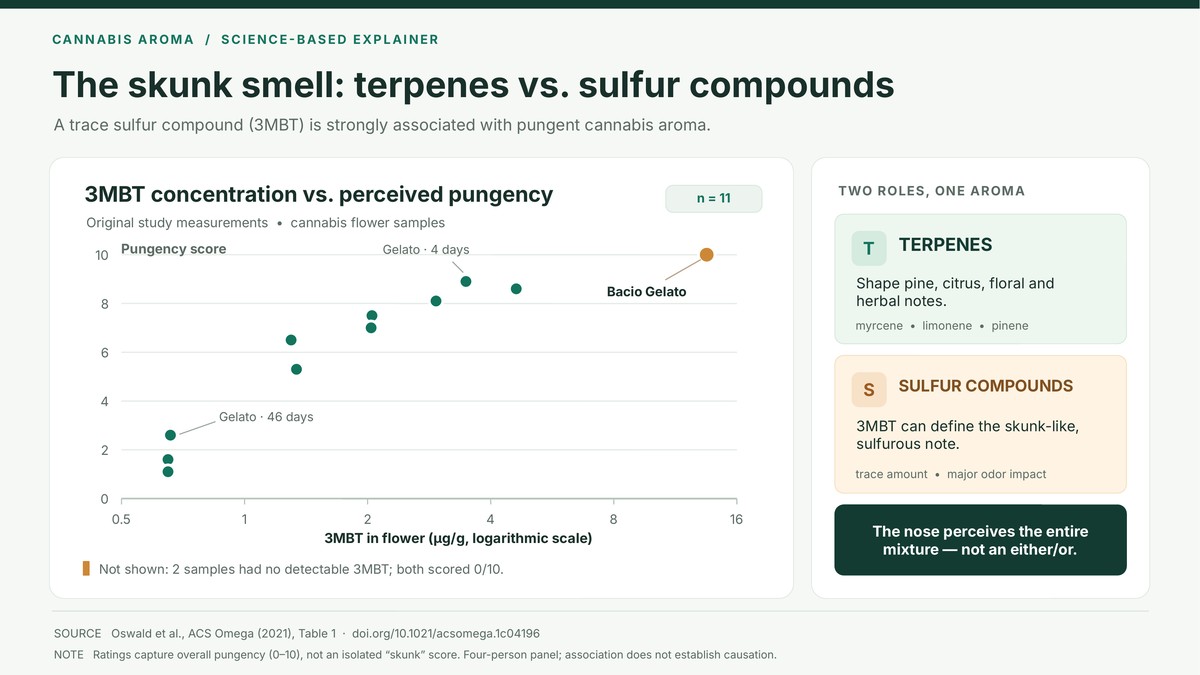
Among these compounds, 3MBT (VSC3) showed a particularly strong association with the characteristic pungent aroma.
The researchers analyzed 13 cannabis cultivars. Two samples illustrated the difference especially clearly:
- Bacio Gelato: Contained approximately 13.5 micrograms of 3MBT per gram of flower and received a pungency score of 10/10.
- Black Jack: Had no detectable 3MBT under the analytical conditions used and received a pungency score of 0/10.
These were scores from a small, four-person sensory panel, not universal ratings for every product carrying those strain names.
More importantly, the researchers performed an aroma reconstruction experiment. A mixture of ten major volatile components from Bacio Gelato did not fully reproduce its recognizable pungency. Adding a small amount of 3MBT substantially changed the aroma, bringing it much closer to the original flower.
This provided evidence that 3MBT was not merely present alongside other cannabis compounds. It played a major role in creating the characteristic smell.
However, the experiment did not establish that 3MBT dominates the aroma of every cannabis strain.
Why Can Such a Small Amount Smell So Strong?
One of the most important principles in odor chemistry is that chemical abundance and perceived odor intensity are not the same thing.
A substance may represent only a tiny fraction of a sample's volatile compounds yet contribute disproportionately to its smell.
This depends partly on its odor detection threshold: the lowest concentration at which people can detect it under specified conditions.
Scientists sometimes use an odor activity value (OAV) to compare a compound's measured concentration with its detection threshold.
A compound with a low threshold can have substantial sensory relevance without appearing as a dominant peak in a routine laboratory report.
However, odor thresholds depend on the medium being tested, and mixtures can produce masking or enhancement effects. An OAV cannot be interpreted as an exact percentage of the smell perceived by a person.
This explains why a cannabis sample containing abundant myrcene or limonene may still owe much of its pungent skunk character to a comparatively small amount of 3MBT.
Terpenes vs. Sulfur Compounds: What Actually Determines Cannabis Aroma?
Terpenes have long been used to describe cannabis aroma profiles. They remain important, but recent research demonstrates that they represent only part of the chemical picture.
The following comparison shows how different compound families contribute to the scent of cannabis.
| Compound or family | Common examples | Typical aroma notes | Importance in cannabis |
|---|---|---|---|
| Prenylated sulfur compounds | 3MBT (VSC3), prenyl thioacetate (VSC5) | Skunky, pungent, sulfurous, savory | Strongly associated with classic skunk-like pungency in studied samples |
| Other volatile sulfur compounds | 3SH, 3SHA, 4MSP | Tropical fruit, passion fruit, citrus, blackcurrant-like notes | Contribute to some fruity and exotic aroma profiles |
| Monoterpenes | Myrcene, limonene, alpha-pinene | Herbal, earthy, citrus, pine | Provide major elements of the background aroma |
| Sesquiterpenes | Beta-caryophyllene, alpha-humulene | Peppery, woody, earthy, herbal | Add depth and complexity to many aroma profiles |
| Oxygenated terpenoids | Linalool, 1,8-cineole | Floral, lavender-like, eucalyptus-like | Contribute floral and fresh notes |
| Other nonterpenoid odorants | Esters, phenols, indoles, aldehydes | Fruity, sweet, spicy, animalic, savory | Help distinguish specific cultivars and unusual aromatic characteristics |
Do Terpenes Cause the Skunky Smell of Weed?
Terpenes contribute to the overall aroma of cannabis, but the available evidence does not support identifying common terpenes such as myrcene as the sole cause of its distinctive skunk odor.
For example:
- Myrcene is commonly associated with herbal, earthy, and musky notes.
- Limonene contributes citrus-like aromas.
- Alpha-pinene is associated with pine needles and resinous freshness.
- Linalool provides floral notes.
- Beta-caryophyllene contributes woody and peppery characteristics.
These molecules can shape how a sulfur-driven skunk note is perceived, even when they are not responsible for creating that specific note.
A 2025 study by Thi Khanh Linh Tran and colleagues, published in the Journal of Agricultural and Food Chemistry, offers particularly useful evidence.
The researchers examined dried flowers from six CBD-rich hemp cultivars using gas chromatography-olfactometry (GC-O) and aroma extract dilution analysis (AEDA).
They identified 52 odor-active compounds, including terpenes, sulfur compounds, phenols, and other aromatic molecules.
Both sulfur-containing molecules and familiar terpenes showed substantial odor activity in the experiments.
The conclusion is more nuanced than the popular claim that terpenes have nothing to do with the smell of cannabis.
Terpenes contribute significantly to the overall bouquet, while particular sulfur compounds can supply the unmistakable skunky character.
Not All Sulfur Compounds Smell Like Skunk
The word "sulfur" often suggests unpleasant smells such as rotten eggs, garlic, or sewage.
That association is incomplete.
Some sulfur-containing molecules have fruity aromas and are also important in the chemistry of wine, hops, and tropical fruits.
Examples include:
3-Sulfanylhexan-1-ol (3SH) can contribute tropical fruit and citrus-like nuances, while 3-sulfanylhexyl acetate (3SHA) is associated with fruity, passion-fruit-like characteristics.
Research published in 2023 and 2024 also identified sulfur compounds linked to distinctive sweet and exotic cannabis aromas.
Therefore, the presence of sulfur does not automatically mean a strain will smell skunky or unpleasant.
The molecular structure, concentration, and surrounding mixture determine the final sensory impression.
Recommended seeds:


Cannabis Skunk Smell vs. Real Skunk Spray: Is It the Same Chemical?
Cannabis and actual skunk spray can produce remarkably similar sensory impressions, but that does not mean their chemical compositions are identical.
In 1990, chemist William F. Wood analyzed the defensive secretion of the striped skunk (Mephitis mephitis).
Among the identified substances were:
- (E)-2-butene-1-thiol
- 3-methyl-1-butanethiol
- Several sulfur-containing thioacetates
These compounds are related in chemical functionality and odor characteristics to sulfur compounds detected in cannabis.
However, they are not identical to cannabis-associated 3-methyl-2-butene-1-thiol.
The resemblance comes from related sulfur chemistry and the sensory properties of the molecules, rather than from cannabis containing an exact copy of skunk defensive secretion.
The Surprising Connection Between Cannabis and Skunky Beer
Interestingly, scientists were familiar with 3MBT long before it became a major focus of cannabis aroma research.
In brewing chemistry, 3MBT is associated with the phenomenon known as lightstruck beer.
When certain compounds in beer undergo photochemical reactions following exposure to light, 3MBT can form and produce an undesirable skunk-like smell.
Studies from the 1990s demonstrated that this molecule could be detected at extremely low concentrations in beer.
The comparison illustrates just how powerful a trace odorant can be.
There is one important qualification: the biochemical and photochemical pathways involved in beer do not automatically explain how 3MBT forms inside a living cannabis plant.
The precise biosynthesis of cannabis-associated prenylthiol remains an active research question.

Why Do Some Cannabis Strains Smell Skunkier Than Others?
Not every cannabis strain produces the same intensity or type of skunk aroma.
Some are described as strongly pungent, while others smell predominantly fruity, floral, herbal, or sweet.
Several factors influence these differences.
1. Genetics and Phenotype
Cannabis genetics influence the biochemical pathways that produce aromatic compounds.
However, plants carrying the same commercial strain name do not necessarily share an identical genotype.
A 2022 study by Schwabe and colleagues examined 32 cannabis samples representing four strain names. Fifteen samples were selected for sensory testing by 55 participants.
Genetically divergent samples frequently received different aroma descriptions from other samples sold under the same name.
This matters because a strain name is not a chemical certificate.
Even closely related plants can display differences in their volatile compounds.
A 2024 study by Paryani and colleagues examined five cannabis phenotypes from one cross and detected meaningful differences in nonterpenoid odorants.
These included molecules associated with tropical and savory aromas.
For a deeper explanation of inherited and expressed traits, see our guide to genotype vs. phenotype in cannabis.
You can also explore why cannabis strains with the same name can have different genetics.
2. Flower Development and Maturity
The production of volatile sulfur compounds changes during plant development.
In the 2021 study by Oswald and colleagues, a small experiment involving four plants of one OG-type cultivar found that several characteristic sulfur compounds became detectable during later flowering.
Their concentrations increased during subsequent development and changed again during drying and curing.
The findings suggest that cannabis aroma is dynamic rather than chemically fixed throughout a plant's life.
However, the experiment was limited to one genetic line and cannot establish a universal timetable for all cannabis cultivars.
3. Drying, Curing, and Storage
The characteristic cannabis smell can change substantially after harvesting.
Volatile molecules may evaporate, oxidize, react with other substances, or change in concentration during processing and storage.
A particularly revealing observation comes from the 2021 study's analysis of two Gelato samples from the same commercial lot.
One sample, examined four days after packaging, contained approximately 3.48 micrograms of 3MBT per gram.
Another, examined 46 days after packaging, contained approximately 0.659 micrograms per gram.
That represents roughly 5.3 times less 3MBT in the older sample, alongside a lower characteristic pungency rating.
The result is consistent with aroma changing during storage. However, it was not a controlled experiment designed to calculate the compound's degradation rate.
Researchers therefore cannot reliably claim that all cannabis loses a fixed percentage of its skunk odor after a specified number of days.
Packaging, temperature, oxygen exposure, moisture, and handling can all influence the outcome.
What Do Marijuana Seeds Tell Us About Skunky Cannabis Genetics?
Cannabis seeds are particularly interesting when examining the relationship between genetics and aroma.
A marijuana seed does not normally emit the characteristic pungent smell of mature cannabis flowers. Instead, it contains the genetic potential for a plant to develop specific chemical characteristics.
That potential includes pathways involved in producing terpenes and other volatile metabolites.
For cannabis breeders and seed collectors, aroma descriptions can be useful indicators of a variety's intended sensory character. However, those descriptions should not be confused with laboratory measurements.
A strain marketed as Skunk, Super Skunk, or Lemon Skunk may be associated with a particular aromatic heritage, but its name does not guarantee a specific 3MBT concentration.
Equally, feminized, regular, and autoflowering seeds describe reproductive or flowering characteristics, not a guaranteed sulfur-compound profile.
At GanjaFarmer.com, enthusiasts can explore a dedicated collection of Skunk cannabis seeds, including classic varieties and more recent crosses. The store also offers feminized cannabis seeds and regular cannabis seeds for different interests and breeding goals.
Those curious about variations on the classic pungent profile can also browse Lemon Skunk genetics, which are traditionally associated with a citrus-influenced aromatic character.
When comparing seed varieties, it is worth examining documented lineage, breeder information, genetic stability, and descriptions from multiple sources rather than relying entirely on a familiar strain name.
For additional background on genetic diversity, our article about landrace cannabis strains and original genetics explains why inherited traits remain important in modern cannabis breeding.
Remember that growing, possessing, and purchasing cannabis seeds are subject to local laws, which vary by jurisdiction.
Recommended seeds:


Why Standard Terpene Tests Cannot Fully Explain Cannabis Smell
A conventional cannabis laboratory report often provides the concentrations of major cannabinoids and a selection of terpenes.
That information can be useful for characterizing the material, but it is not necessarily sufficient to explain what a person smells.
The Limitations of Regular GC-MS Testing
Gas chromatography-mass spectrometry (GC-MS) is widely used to identify volatile compounds.
However, specialized sulfur odorants may be present at concentrations that are difficult to identify reliably using a routine analytical method.
This creates a fundamental problem: a compound can be important to the human nose while remaining difficult to detect or identify confidently with a particular laboratory procedure.
Researchers therefore use complementary techniques.
| Analytical technique | What it does | Why it matters |
|---|---|---|
| GC-MS | Separates and identifies volatile chemicals | Provides a broad chemical profile |
| GC×GC-TOF-MS | Uses two-dimensional separation with mass spectrometry | Helps resolve complex mixtures and overlapping compounds |
| GC-SCD | Uses sulfur-selective chemiluminescence detection | Helps detect sulfur-containing molecules |
| GC-O | Combines chromatography with human smelling | Identifies compounds that are actually odor-active |
| AEDA | Evaluates odorants after successive dilutions | Helps identify compounds with high sensory relevance |
| HPLC-MS/MS | Enables targeted quantification of selected molecules | Can support sensitive measurement of specific thiols |
No single method provides a complete description of how cannabis will smell to every person.
What Independent Research Found in 2025
A study led by Solomon E. Isaacson at Oregon State University, published in PLOS ONE, evaluated the aroma of 91 cannabis samples using 25 sensory descriptors.
The researchers examined 59 CBD-dominant samples and 32 THC-dominant samples.
In the CBD-dominant group, their sulfur-selective analyses detected 43 chromatographic signals attributed to sulfur compounds, but only eight compounds could be identified confidently using the available reference standards.
The researchers also encountered problems with the analytical reference material needed to confirm 3MBT.
Consequently, their inability to confirm that molecule unequivocally should not be interpreted as proof that it was absent.
The study also found that chemical measurements did not reliably predict the complete sensory profiles reported by participants.
This reinforces a central finding of modern cannabis aroma research: knowing which molecules are present is not the same as knowing how their mixture will smell.
Why Sensory Testing Still Matters
Odor specialist Don Wright highlighted the importance of identifying the relatively small number of compounds that may dominate an environmental odor.
In a 2022 article published in Environmental Health Perspectives, Wright explained:
"There's typically just a handful of compounds, in some cases one or two."
His observation helps explain why measuring every abundant volatile compound may be less useful than identifying the odorants responsible for a particular sensory characteristic.
For meaningful aroma evaluation, the strongest approach combines chemical identification, appropriate analytical standards, sensitive detection methods, and controlled human sensory assessment.
Does Skunkier Weed Mean Stronger Weed?
The assumption that stronger-smelling cannabis must contain more THC is not supported by reliable scientific evidence.
Smell intensity is not a dependable measure of THC potency.
THC and aromatic volatile compounds belong to different chemical categories and are measured using different analytical approaches.
A 2018 study by Avery N. Gilbert and Joseph A. DiVerdi examined consumer perceptions of cannabis aroma.
Participants associated some aroma profiles with higher expected potency, but their expectations did not show a meaningful correlation with the measured THC content of the samples.
In other words, people may perceive a pungent smell as a sign of strength without that perception accurately reflecting cannabinoid concentration.
The same distinction applies to quality.
A pronounced skunk aroma may be desirable to some consumers and unpleasant to others. Neither reaction establishes the safety, purity, potency, or overall quality of the material.
Aroma is a sensory characteristic, not a substitute for verified laboratory testing.
Can You Preserve or Reduce the Skunk Smell of Cannabis?
Because cannabis aroma depends on numerous volatile compounds, controlling it is more complicated than simply increasing or decreasing terpene concentration.
Preserving Aroma During Storage
For legally possessed cannabis flower, general storage principles aimed at limiting unnecessary chemical changes include:
-
Using well-sealed, suitable containers to reduce the escape of volatile compounds.
-
Limiting unnecessary exposure to heat and direct light.
-
Avoiding repeated opening and prolonged exposure to air.
-
Maintaining appropriate storage conditions that preserve product quality without encouraging excess moisture or microbial growth.
These measures may help limit changes in the overall aroma, but they do not guarantee preservation of the original concentration of 3MBT or other odorants.
Different compounds can respond differently to storage conditions.
Reducing Odor Emissions
For licensed cannabis facilities, odor management presents a separate technical challenge.
Activated carbon filtration and other ventilation-based systems can help manage emissions, but their effectiveness depends on factors such as airflow, humidity, contact time, filter condition, and the compounds involved.
A system that efficiently reduces dominant terpene emissions does not necessarily remove trace sulfur odorants to the same degree.
The distinction became apparent in the Carpinteria greenhouse area in California.
After odor-control technologies had improved general conditions, growers continued receiving complaints about the characteristic skunk odor.
Autumn Shelton, representing CARP Growers, told Environmental Health Perspectives:
"We still were getting complaints about the skunky smell."
The observation was a reported field experience, not a controlled laboratory measurement of thiol removal.
Nevertheless, it illustrates why odor-management strategies need to address the specific molecules causing a problem rather than treating all volatile emissions as equivalent.
Importantly, a strong smell does not automatically mean toxic exposure. Conversely, odor nuisance and local air-quality concerns should not be dismissed merely because a substance can be detected at low concentrations.
What Has Cannabis Aroma Research Discovered in 2026?
Scientific understanding of cannabis sulfur chemistry is still developing.
Two areas are receiving particular attention: more accurate measurement of trace thiols and the biological mechanisms responsible for their formation.
More Accurate Quantification of Cannabis Thiols
A study by Amandine André and colleagues, published in the Journal of Agricultural and Food Chemistry in 2026, introduced a targeted HPLC-MS/MS approach for measuring four important odor-active thiols in hemp.
These included 3MBT, 4MSP, 3SH, and 3SHA.
The method incorporated chemical derivatization and stable isotope dilution analysis to improve quantitative reliability.
Such techniques may help researchers distinguish genuine differences between cannabis samples from limitations introduced by sample preparation and instrumentation.
Could Cannabis Store Its Skunk Aroma in Hidden Precursors?
An intriguing 2026 conference abstract presented at the National Cannabis Research Conference proposed that cannabis may contain nonvolatile precursors capable of releasing sulfur odorants.
The proposed molecules include sulfur-containing conjugates associated with glutathione and cysteine metabolism.
Under certain experimental conditions, these compounds may release volatile thiols.
If independently confirmed, this mechanism could help explain why measuring free 3MBT at one moment does not necessarily reveal a sample's full potential to generate sulfur-related odors later.
However, these findings were reported in a conference abstract rather than a fully published, independently replicated study. They should therefore be regarded as preliminary.
Another 2026 preprint, by Babaei, Goulet, and Torkamaneh, examined 165 commercial cannabis genotypes.
Its odor-activity estimates suggested a substantial contribution from prenylthiol, representing approximately 67–77% of the summed estimated odor activity values across three identified chemotypes.
That does not mean 3MBT causes 67–77% of the smell perceived by humans. The calculation is model-based, depends on odor-threshold assumptions, and does not directly measure the proportional contribution of individual compounds to human perception.
The preprint also requires further peer-reviewed validation.
Together, these emerging findings point toward a future in which cannabis aroma classification considers not only terpene composition but also sulfur chemistry, precursor molecules, and genetic variation.
Frequently Asked Questions About Skunky Cannabis Smell
Why Does Weed Smell Like Skunk but Not Exactly Like Skunk Spray?
Cannabis contains odor-active sulfur compounds that can produce a similar pungent sensation. However, the specific mixture of molecules differs from the defensive secretion of actual skunks.
What Terpene Makes Weed Smell Like Skunk?
No single common terpene has been established as the main explanation for classic cannabis skunk odor. Evidence particularly implicates 3MBT, a volatile sulfur compound, while terpenes contribute additional aromatic notes.
Can Cannabis Smell Skunky Without a High Terpene Concentration?
Yes. Trace sulfur compounds may contribute substantially to the perceived skunk note even when the measured concentrations of major terpenes are relatively modest. The overall aroma still depends on the complete chemical mixture.
Do Cannabis Seeds Naturally Smell Like Skunk?
Cannabis seeds do not normally possess the characteristic pungent odor of mature flowers. Their importance lies in the genetic traits that may influence the chemical profile of the plants produced from them.
Does a Strong Skunk Smell Mean Cannabis Has More THC?
No. Research does not support using skunk odor intensity as a reliable indicator of THC content or psychoactive potency.
Why Does the Skunk Smell Fade Over Time?
Volatile sulfur compounds and other aromatic molecules may be lost or chemically transformed during storage. Temperature, light, oxygen, packaging, and product history can influence how the aroma changes.
Conclusion: Sulfur Creates the Skunk Note, but Terpenes Complete the Aroma
So, what makes cannabis smell like skunk?
The best-supported scientific explanation is that trace volatile sulfur compounds, especially 3-methyl-2-butene-1-thiol, are major contributors to the characteristic skunky scent found in certain cannabis samples.
Terpenes remain essential to the broader fragrance, adding the earthy, herbal, citrus, pine, and floral characteristics that make different varieties recognizable.
Other molecules, including esters, phenols, indoles, and additional sulfur compounds, further modify the final aroma.
The most important lesson is that cannabis scent cannot be understood from terpene percentages, THC levels, or strain names alone.
Understanding why cannabis smells the way it does requires looking at the complete chemical mixture, the plant's genetics, the condition of the material, and — ultimately — what the human nose actually detects.
Bibliography
-
Oswald, I. W. H., et al. (2021). Identification of a New Family of Prenylated Volatile Sulfur Compounds in Cannabis Revealed by Comprehensive Two-Dimensional Gas Chromatography. ACS Omega, 6(47), 31667–31676.
-
Oswald, I. W. H., et al. (2023). Minor, Nonterpenoid Volatile Compounds Drive the Aroma Differences of Exotic Cannabis. ACS Omega, 8(42), 39203–39216.
-
Paryani, T. R., et al. (2024). Nonterpenoid Chemical Diversity of Cannabis Phenotypes Predicts Differentiated Aroma Characteristics. ACS Omega, 9(26), 28806–28815.
-
Tran, T. K. L., et al. (2025). The Plant of Many Scents: Unraveling the Odorant Composition of Selected CBD Hemp Cultivars. Journal of Agricultural and Food Chemistry, 73(38), 24314–24325.
-
Isaacson, S. E., Wilson-Poe, A. R., Ye, T., Qian, Y. L., & Shellhammer, T. H. (2025). Beyond Potency: A Proposed Lexicon for Sensory Differentiation of Cannabis sativa L. Aroma. PLOS ONE, 20(10), e0335125.
-
André, A., Tran, T. K. L., Gillich, E., Katsir, L., & Chetschik, I. (2026). First Quantitation of Key Odor-Active Thiols in Flowers of Different Hemp Cultivars Using HPLC-MS/MS. Journal of Agricultural and Food Chemistry, 74(1), 1379–1387.
-
Gilbert, A. N., & DiVerdi, J. A. (2018). Consumer Perceptions of Strain Differences in Cannabis Aroma. PLOS ONE, 13(2), e0192247.
-
Schwabe, A. L., Naibauer, S. K., McGlaughlin, M. E., & Gilbert, A. N. (2022). Human Olfactory Discrimination of Genetic Variation Within Cannabis Strains. Frontiers in Psychology, 13, 942694.
-
Wood, W. F. (1990). New Components in Defensive Secretion of the Striped Skunk, Mephitis mephitis. Journal of Chemical Ecology, 16(6), 2057–2065.
-
Seltenrich, N. (2022). Odor Control in the Cannabis Industry: Lessons from the New Kid on the Block. Environmental Health Perspectives, 130(6), 062001.
-
Babaei, M., Goulet, C., & Torkamaneh, D. (2026). Volatile Profiling and Estimated Odor-Activity Analysis of Commercial Drug-Type Cannabis Accessions. bioRxiv. Preprint; not peer-reviewed at the time considered.
-
National Cannabis Research Conference (2026). Hidden Conjugate Pools Underlie Prenylated Volatile Sulfur Emission from Cannabis. Conference Program and Abstracts, Abstract 0124. Preliminary conference report.
 USA
 Česko
 Deutschland
 España
 France
 Italia
 Nederland
 Polska
 Europe