

Minor cannabinoids are naturally occurring cannabis compounds typically found in smaller amounts than THC or CBD. The best-known examples include CBG (cannabigerol), CBC (cannabichromene), THCV (tetrahydrocannabivarin), CBN (cannabinol), and CBDV (cannabidivarin). Each has a distinct chemical structure, biological activity, and research history.
CBG has preliminary human data relating to anxiety, CBC is attracting attention for its unusual receptor interactions, and THCV is being investigated for its metabolic effects. However, none of these findings establishes CBG, CBC, or THCV as a proven treatment for anxiety, chronic pain, insomnia, or weight loss.
Understanding minor cannabinoids requires looking beyond potential benefits. Their chemistry, the genetics of cannabis plants, the quality of laboratory measurements, and the design of clinical trials are just as important as their effects on receptors.
What Are Minor Cannabinoids?
The term minor cannabinoid describes the relative abundance of a compound in cannabis, not its strength, safety, or legal status.
In many commercial cannabis varieties, THC and CBD dominate the cannabinoid profile. Other compounds may appear at concentrations ranging from trace amounts to several percentage points, depending on the plant's genetics and development.
Some specialized cannabis chemotypes can accumulate substantial quantities of cannabinoids that would otherwise be considered minor. CBG-rich plants are a good example.
This distinction matters for three reasons:
- Low concentration does not mean low biological activity. A compound present in tiny amounts may interact strongly with a particular molecular target.
- Receptor activity does not guarantee a noticeable human effect. Absorption, metabolism, dose, and formulation all influence what happens after administration.
- A minor cannabinoid is not necessarily a safer cannabinoid. For many compounds, long-term human safety data remain limited.
In other words, the word minor describes the chemistry of the plant, not the importance of the molecule.
CBG vs. CBC vs. THCV: Key Differences
The following comparison separates what researchers have actually observed from claims that remain unproven.
| Cannabinoid | Full name | Main scientific interest | What human evidence shows | What remains unproven |
|---|---|---|---|---|
| CBG | Cannabigerol | Anxiety, inflammation, antibacterial activity, pharmacokinetics | A small controlled trial found a modest improvement in one anxiety measure; a separate sleep trial did not meet its primary endpoint | Established treatment for anxiety, insomnia, pain, or infection |
| CBC | Cannabichromene | CB2 and TRPA1 receptor activity, inflammation, neural cell biology | Limited pharmacokinetic research involving products containing other cannabinoids | Clinical pain relief, neuroregeneration, or anti-inflammatory efficacy |
| THCV | Tetrahydrocannabivarin | Glucose metabolism, appetite regulation, CB1-related signaling | A small diabetes trial found a secondary glucose-related signal; a weight study tested THCV together with CBD | Reliable appetite suppression or weight loss from THCV alone |
| CBN | Cannabinol | Sleep and cannabinoid degradation | Controlled sleep studies have produced mixed results, including negative primary outcomes | A clinically established sleep aid |
| CBDV | Cannabidivarin | Epilepsy and neuronal signaling | A phase II trial did not demonstrate a significant reduction in focal seizures versus placebo | Proven anticonvulsant efficacy |
| THCP | Tetrahydrocannabiphorol | CB1 receptor binding and cannabinoid structure | Very limited direct human evidence | Claims that it produces 33 times the intoxicating effect of THC |
The most useful comparison is not which cannabinoid is supposedly the strongest. It is which specific effect has been demonstrated, in which model, and with what degree of confidence.
How Are Minor Cannabinoids Produced in Cannabis?
CBGA Is an Important Precursor, but CBG Is Not the “Mother of All Cannabinoids”
Cannabis produces many cannabinoids initially in their acidic forms.
One important intermediate is cannabigerolic acid (CBGA). Specialized enzymes convert CBGA into several other cannabinoid acids:
- THCA synthase (THCAS) converts CBGA into THCA, which can decarboxylate into THC.
- CBDA synthase (CBDAS) converts CBGA into CBDA, which can decarboxylate into CBD.
- CBCA synthase (CBCAS) converts CBGA into CBCA, which can decarboxylate into CBC.
CBGA can also decarboxylate into neutral CBG.
Decarboxylation is the chemical process in which a cannabinoid acid loses carbon dioxide. Heat accelerates it, although the conversion can also occur gradually during processing and storage.
This explains why calling CBG the mother of all cannabinoids is scientifically imprecise. CBGA, not neutral CBG, is the common precursor in the major pentyl cannabinoid pathway.
For a more detailed look at the enzymes responsible, see GanjaFarmer's guide to THCA and CBDA synthase genes.
THCV Comes From a Different Biosynthetic Branch
THCV is structurally related to THC but belongs to the varin cannabinoid family.
Whereas THC has a five-carbon alkyl side chain, THCV has a three-carbon side chain. This structural difference affects its pharmacology.
The varin pathway includes:
CBGVA → THCVA → THCV
Here, CBGVA is cannabigerovarinic acid and THCVA is tetrahydrocannabivarinic acid.
This is why the popular explanation that every cannabinoid comes directly from CBG is incomplete. Cannabis uses related but distinct precursor pathways to produce different molecular families.
CBG (Cannabigerol): Promising Research, Limited Clinical Proof
CBG is one of the better-studied minor cannabinoids, but its scientific reputation often runs ahead of the available evidence.
Preclinical research has explored CBG in relation to inflammation, cellular signaling, neurological function, and bacterial growth. Yet a result in a cell culture or animal model cannot be treated as evidence that a commercial CBG product will produce the same benefit in humans.
Does CBG Help With Anxiety?
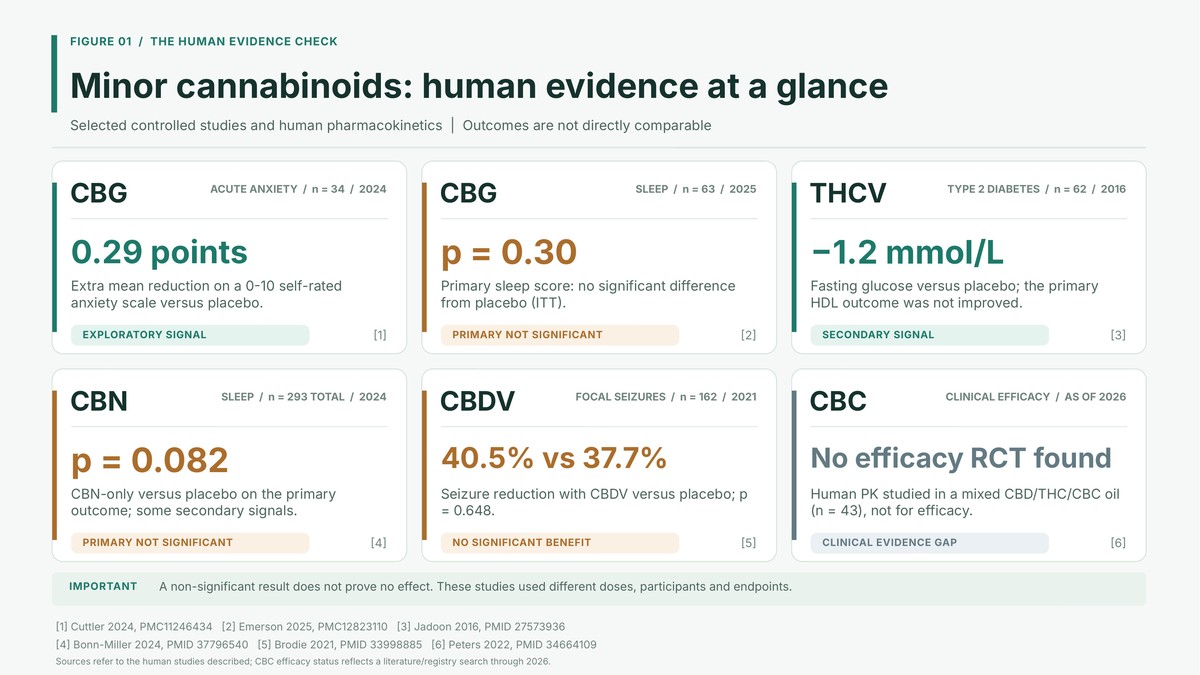
A 2024 randomized, double-blind, placebo-controlled crossover study by Carrie Cuttler and colleagues investigated 20 mg of CBG in 34 healthy adults with previous cannabis experience.
The researchers measured anxiety using several methods.
On a 0–10 visual analogue scale, the average reduction in anxiety was:
- 0.95 points with CBG
- 0.66 points with placebo
The difference between those reductions was 0.29 points.
The result was statistically encouraging, but the absolute difference was small. Importantly, another established anxiety measure, the State-Trait Anxiety Inventory (STAI), did not show a statistically significant benefit.
The participants were not patients diagnosed with an anxiety disorder. The sessions were conducted remotely, and the researchers did not correct all analyses for multiple comparisons.
Consequently, the study supports further investigation, not a claim that CBG treats clinical anxiety.
Commenting on the research, Carrie Cuttler of Washington State University cautioned:
“We need to avoid claims that CBG is a miracle drug.”
That distinction is fundamental: an interesting experimental effect is not the same thing as an established therapeutic indication.
What Do CBG Sleep Studies Show?
A separate randomized trial involving 63 veterans tested CBG against placebo over four weeks. Participants received 25 mg daily during the first two weeks, followed by 50 mg daily during the next two.
Although sleep-related scores improved during the study, CBG did not significantly outperform placebo on the primary sleep outcome.
This negative result matters because improvements reported by participants can arise from expectations, natural symptom fluctuations, or other factors unrelated to the active substance.
The study does not prove that CBG can never influence sleep. It shows that the particular formulation, doses, study population, and trial design did not establish the proposed benefit.
What About CBG Safety and Other Potential Uses?
A 2026 human pharmacokinetic study examined single oral CBG doses ranging from 25 to 200 mg in 12 adults.
The researchers observed substantial differences in how participants processed the compound. Changes in subjective appetite were also reported at the highest dose.
These findings highlight the importance of studying absorption and metabolism before assuming that the same amount of CBG produces equivalent effects in everyone.
CBG has also shown activity against methicillin-resistant Staphylococcus aureus (MRSA) in preclinical experiments. This is scientifically interesting, but it does not establish CBG as a treatment for bacterial infections.
CBG research is moving forward, but the evidence still does not support broad medical claims.
CBC (Cannabichromene): An Interesting Cannabinoid With a Stereochemistry Problem
CBC receives less attention than CBG or THCV, partly because convincing clinical efficacy research remains scarce.
Laboratory studies have explored its interactions with molecular targets including CB2 and TRPA1. These receptors and ion channels participate in processes associated with sensory signaling and inflammation.
However, activating a receptor in an experimental system does not prove that CBC relieves pain or reduces inflammation in patients.
Why the Two Forms of CBC Matter
One of the most revealing findings about CBC concerns stereochemistry.
Some molecules exist in two spatial arrangements that are mirror images of one another. These forms are called enantiomers.
In research published online in 2024 and subsequently in a 2025 journal issue, Michael Udoh and colleagues compared two CBC enantiomers:
- (−)-CBC activated CB2 receptors, with an EC₅₀ of approximately 1.5 µM.
- (+)-CBC did not produce comparable CB2 activation at the concentrations tested, up to 30 µM.
Both compounds were chemically CBC, but their behavior at CB2 differed substantially.
That raises an important question about older studies: when researchers reported an effect of “CBC,” which stereochemical form did they actually test?
It also complicates the evaluation of commercial isolates. A simple statement that a product contains a certain percentage of CBC may not completely describe its pharmacological properties.
Does CBC Promote Neurogenesis?
CBC is sometimes promoted as a cannabinoid that encourages the growth of new brain cells.
The frequently cited evidence comes from a 2013 experiment by Shinjyo and Di Marzo involving mouse neural stem and progenitor cells under laboratory conditions.
The researchers observed changes in cell viability and differentiation-related markers.
They did not demonstrate that CBC regenerates damaged human brain tissue, improves memory, or prevents neurodegenerative disease.
There is also preliminary human research on the pharmacokinetics of CBC administered in a product containing CBD and THC. In a pilot study involving 43 people, CBC reached peak plasma concentrations approximately 1.6–4.3 hours after administration.
Because the formulation contained other cannabinoids, this study cannot establish the clinical effects of CBC alone.
The central CBC research question is no longer simply whether the molecule is biologically active. It is whether a well-characterized CBC preparation produces a meaningful, reproducible benefit in humans.
THCV (Tetrahydrocannabivarin): Is “Diet Weed” Supported by Science?
THCV is commonly described online as an appetite-suppressing or weight-loss cannabinoid.
These claims are premature.
Studies involving THCV fall into several categories: receptor pharmacology, brain imaging, metabolic measurements, and investigations of combination products. They cannot be combined into a single claim of proven weight-loss efficacy.
THCV and Blood Glucose
A 2016 randomized study by Jadoon and colleagues investigated CBD, THCV, and their combinations in 62 people with type 2 diabetes over 13 weeks.
One treatment group received 5 mg of THCV twice daily.
Researchers reported an estimated reduction in fasting plasma glucose of approximately 1.2 mmol/L relative to placebo.
This was an interesting metabolic signal. However, the study did not demonstrate the expected benefit on its primary HDL cholesterol endpoint, and it did not establish THCV as a weight-loss treatment.
The authors wrote that:
“THCV could represent a new therapeutic agent in glycemic control.”
The word could is important. It expresses a possibility requiring confirmation, not a conclusion that THCV is an effective diabetes medication.
Does THCV Reduce Appetite or Body Weight?
Some experiments have investigated how THCV influences brain responses to food-related stimuli. However, altered brain activation during a laboratory task is not equivalent to reduced calorie intake or sustained weight loss.
A 2025 study involving 44 participants reported encouraging weight-related findings after 90 days of treatment with mucoadhesive strips containing:
- 8 mg THCV combined with 10 mg CBD, or
- 16 mg THCV combined with 20 mg CBD.
The critical limitation is that the study did not include a THCV-only treatment group.
Therefore, the results cannot establish whether THCV, CBD, their interaction, or the formulation itself contributed to the reported changes.
The available evidence does not justify calling THCV a proven appetite suppressant or slimming ingredient.
Is THCV Psychoactive?
THCV has dose- and context-dependent interactions with cannabinoid signaling, including CB1-related mechanisms.
Its pharmacological behavior is not identical to that of THC, but this does not justify describing every THCV formulation as non-intoxicating or universally safe for driving.
The actual effects depend on dose, delivery method, product composition, and individual response. Coexisting THC is an especially important consideration in cannabis-derived products.
For now, THCV is best described as a cannabinoid under investigation for metabolic and neurological effects, not as an established weight-management solution.
For readers interested in the genetics behind THCV-oriented strain descriptions, the following two varieties illustrate different breeding backgrounds. Product descriptions should not be treated as substitutes for verified, batch-specific THCV measurements.
Recommended seeds:

Beyond CBG, CBC, and THCV: Other Minor Cannabinoids Worth Understanding
CBN: Is It Really a Sleep Cannabinoid?
Cannabinol (CBN) is often associated with aged cannabis because it can form through the oxidative degradation of THC.
Its reputation as a sleep aid is much stronger than the available clinical evidence.
In a 2024 placebo-controlled study, the main sleep-quality comparison involving 20 mg CBN alone did not reach statistical significance, although some secondary sleep-related measures were favorable.
A separate 2026 crossover trial involving 20 participants used polysomnography to measure sleep objectively. At a dose of 300 mg, CBN did not significantly improve the primary measure of wake after sleep onset.
This does not rule out every possible sleep-related effect, but it prevents a confident claim that CBN is a clinically proven sedative.
CBDV: A Reminder That Promising Cannabinoids Can Fail Clinical Trials
Cannabidivarin (CBDV) belongs to the varin family, like THCV.
Its potential anticonvulsant properties generated interest because CBD has demonstrated efficacy in certain specific epilepsy conditions.
However, similarity between molecules does not guarantee similarity in clinical performance.
In a phase II randomized trial involving 162 people with inadequately controlled focal seizures, seizure frequency fell by:
- 40.5% in the CBDV group
- 37.7% in the placebo group
The difference was not statistically significant (p = 0.648).
This is a particularly valuable result because it demonstrates why cannabinoid research requires properly controlled human trials rather than extrapolation from chemical structure or animal studies.
THCP: Does Greater Receptor Affinity Mean Greater Potency?
Tetrahydrocannabiphorol (THCP) attracted considerable attention after researchers reported approximately 33-fold greater binding affinity for CB1 receptors than THC in a particular experimental system.
That number is frequently misrepresented.
Binding affinity describes how strongly a molecule associates with a receptor under specified conditions. It does not directly establish:
- How much of the compound reaches the brain.
- How effectively it activates a receptor.
- How long it remains in the body.
- How intoxicating or toxic it is in humans.
Therefore, “33 times greater CB1 affinity” does not mean “33 times stronger than THC” in real-world use.
Cannabis Seeds, Chemotypes, and the Genetics of Minor Cannabinoids
For anyone researching minor cannabinoids in relation to marijuana seeds, one distinction is essential: a seed's genetic potential is not the same as the measured cannabinoid profile of a mature plant.
Cannabis plants contain genes encoding enzymes involved in cannabinoid biosynthesis. Different combinations of functional genes, gene expression patterns, and biochemical pathways influence which cannabinoid acids accumulate in the flowers.
Breeders can select plants for traits such as CBG dominance, CBD-rich profiles, or particular cannabinoid ratios. However, the final chemical composition can also vary with plant development, environmental conditions, and post-harvest processing.
A strain name alone is not a laboratory specification.
This is especially relevant to commercially advertised THCV-rich or CBG-rich cannabis seeds. A breeder's description may indicate a selection objective or an observed characteristic, but it does not guarantee the same cannabinoid percentages in every individual plant or production batch.
Why More Cannabinoid Genes Do Not Always Mean More Cannabinoids
A 2025 cannabis pangenome study by Lynch and colleagues examined 193 genome assemblies and investigated variation in cannabinoid synthase genes.
The researchers identified complete CBCAS-related sequences in 110 genomes, or approximately 56%.
Yet CBCA was rarely detected in a much larger set of chemical analyses.
This apparent contradiction highlights a fundamental principle of cannabis genetics: the presence of a gene does not guarantee that the corresponding compound will accumulate at measurable concentrations.
Gene functionality, expression, enzyme activity, substrate availability, and other biological factors all influence the resulting chemotype.
For additional context, explore GanjaFarmer's articles on genotype versus phenotype in cannabis and why strains with the same name can have different genetics.
What Should Seed Buyers Look For?
When comparing marijuana seeds for cannabinoid-related research or lawful cultivation, consider the following:
- Documented genetics: Look for information about the breeding line and its selection history.
- Cannabinoid data: Prefer actual laboratory analyses over general claims such as “high minor cannabinoid content.”
- Consistent sampling: Results from multiple plants or batches are more informative than a single unusually favorable test.
- Acidic versus neutral cannabinoids: CBGA and CBG, for example, should not be treated as identical measurements.
- The correct trait: Feminized, autoflowering, and regular describe seed or flowering characteristics, not a guaranteed CBG, CBC, or THCV concentration.
GanjaFarmer.com offers a range of genetics for readers comparing different cannabis profiles, including its CBD cannabis seeds and regular marijuana seeds. These categories can be useful starting points for understanding how breeders organize varieties, provided that marketing descriptions are distinguished from verified analytical results.
The following selections illustrate CBD-oriented and mixed-cannabinoid breeding profiles. Neither product should be assumed to contain a specific quantity of CBG, CBC, or THCV without supporting laboratory data.
Recommended seeds:


How Accurate Are Minor Cannabinoid Lab Tests?
Laboratory testing is one of the most overlooked issues in discussions of minor cannabinoids.
Measuring THC or CBD at relatively high concentrations is not the same analytical problem as measuring trace amounts of THCV or CBC.
At very low concentrations, laboratories face challenges involving interfering substances, overlapping chromatographic peaks, reference standards, sample preparation, and limits of quantitation.
What the NIST Research Revealed
In its 2024 Cannabis Laboratory Quality Assurance Program report, the US National Institute of Standards and Technology (NIST) examined results obtained by participating laboratories.
For a specific reference hemp sample, approximately 91% of the laboratories that reported a numerical THCV result fell outside the target range.
This figure must be interpreted carefully. It describes a particular sample and a subset of participants in an interlaboratory comparison. It does not mean that 91% of all commercial cannabinoid tests are inaccurate.
The NIST report also illustrated a chromatographic identification problem: a signal initially assigned to THCV based on retention time did not have an absorption spectrum matching the THCV reference standard.
In practical terms, a laboratory can sometimes detect a peak at an expected position without having enough evidence to identify it confidently.
Why a Number on a Certificate of Analysis Is Not Enough
Imagine two products:
- Product A reports THCV: 0.01%, with no explanation of the analytical method or detection limits.
- Product B reports THCV: below the limit of quantitation, and identifies the validated method and its LOQ.
The second result may be more scientifically informative, even though it appears less impressive.
A highly precise-looking number is not necessarily an accurate measurement.
A 2025 independent audit of 277 cannabis products purchased in Colorado also found that approximately 84% did not list values for the minor cannabinoid panel examined by the researchers.
The issue is therefore not only potentially incorrect testing. In many cases, consumers are not provided with minor cannabinoid information at all.
Practical Checklist: How to Read a COA for CBG, CBC, or THCV
A credible certificate of analysis (COA) should allow the reader to answer several basic questions:
- Which batch was tested? Check the product identification, batch number, sample date, and analysis date.
- What sample type was analyzed? Flower, extract, oil, and edible products require appropriate testing methods.
- Which cannabinoids were measured? Look for separate results for relevant acidic and neutral forms, such as CBGA and CBG.
- What method was used? Techniques such as HPLC-DAD, HPLC-PDA, and LC-MS/MS can be appropriate when properly validated.
- How low can the method measure reliably? Look for the limit of detection (LOD) and limit of quantitation (LOQ).
- How was compound identity confirmed? This is particularly important where chromatographic peaks may overlap.
- Were contaminants assessed? Relevant testing may include pesticides, residual solvents, heavy metals, and microbiological contamination.
- Does the result match the advertised product? A COA from a different batch or formulation cannot automatically validate the item being sold.
These are scientific quality considerations, not a claim that every jurisdiction requires every test for every product type.
For minor cannabinoids, measurement quality can be just as important as the reported concentration.
How Are Minor Cannabinoids Produced Commercially?
Because some cannabinoids occur at low concentrations in conventional cannabis material, obtaining useful quantities can be technically challenging.
Several production approaches are under investigation or already used in different contexts.
Plant Breeding and Extraction
Selective breeding can increase the proportion of a desired cannabinoid in the plant.
Extraction and purification can then separate cannabinoids from other plant compounds.
Challenges include variable raw material, chemically similar impurities, low target concentrations, and the need to preserve product quality throughout processing.
Chemical Synthesis and Bioconversion
Some cannabinoids can be produced or transformed through chemical reactions or enzyme-assisted processes.
These approaches create additional questions about reaction by-products, stereochemistry, purification, and regulatory classification.
A molecule's chemical identity alone may not determine how a particular jurisdiction regulates the finished product; its manufacturing route can also matter.
Precision Fermentation
Scientists are also engineering microorganisms to produce cannabinoid intermediates or finished cannabinoids.
In a 2024 study, Ding and colleagues reported 138 mg/L of CBG using engineered Saccharomyces cerevisiae in a five-liter fed-batch bioreactor.
This represents meaningful progress in metabolic engineering.
However, production concentration is not the same as commercial profitability.
A realistic manufacturing assessment must also consider equipment, raw materials, energy, downstream separation, product recovery, testing, waste handling, and regulatory requirements.
Fermentation may expand the options for producing rare cannabinoids, but laboratory success does not automatically establish an economical industrial process.
Are Minor Cannabinoids Safe? What About Drug Interactions?
Safety cannot be inferred simply because a cannabinoid occurs naturally in cannabis.
Many minor cannabinoids have been studied in isolated cells or animals far more extensively than in humans.
Important unanswered questions include:
- What happens after repeated exposure over months or years?
- How do different delivery methods affect absorption and metabolism?
- Can a cannabinoid interfere with medication-metabolizing enzymes or transporters?
- How do other cannabinoids in the same formulation change its effects?
- Are there risks for specific populations, including pregnant individuals or people taking prescription medicines?
Laboratory findings involving CYP450 enzymes can signal possible drug interactions, but these findings must be evaluated in humans before a reliable clinical risk estimate can be made.
Similarly, a cannabinoid that produces no obvious intoxication in one short study should not automatically be described as risk-free or compatible with driving.
Does the Entourage Effect Make Minor Cannabinoids More Effective?
The entourage effect refers to the hypothesis that cannabis compounds may influence one another's biological activity.
Such interactions are biologically plausible in certain systems, but the presence of several cannabinoids in an extract does not prove therapeutic synergy.
To demonstrate a specific benefit from a combination, researchers need suitable comparisons involving the individual substances, the mixture, and placebo.
A product containing CBG, CBC, CBD, and terpenes should therefore not be assumed to work better than a single-compound formulation merely because its ingredient list is longer.
Are CBG, CBC, and THCV Legal?
The legal status of a minor cannabinoid depends on the country, the substance, its source, the method of production, and the intended product category.
A cannabinoid originating from legally cultivated hemp is not automatically authorized for sale as a food, supplement, medicine, or other consumer product.
United States: Important Federal Changes in Late 2026
As of October 31, 2026, US federal hemp legislation is approaching a significant transition.
Amendments introduced by Public Law 119-37 address matters including total THC, certain cannabinoids manufactured outside the plant, and thresholds for defined finished hemp-derived products.
However, the implementation timetable changed.
According to the Congressional Research Service's October 28, 2026 analysis, Public Law 119-103 delayed most amendments to December 11, 2026.
A particular exclusion involving hemp-derived products containing cannabinoids not capable of being naturally produced by the cannabis plant is still scheduled to take effect on November 12, 2026.
These distinctions are important. It would be inaccurate to claim that every CBG, CBC, or THCV product becomes subject to the same rule on the same date.
State-level restrictions and other federal laws may also apply.
European Union: Hemp Cultivation Is Not the Same as Food Authorization
In the European Union, agricultural rules governing hemp cultivation and rules governing cannabinoid ingredients in food address different legal questions.
A plant may satisfy relevant cultivation requirements without an isolated cannabinoid ingredient being authorized for use in a food product.
The EU novel food framework is particularly relevant to cannabinoid extracts and isolates intended for consumption.
In February 2026, the European Food Safety Authority published a provisional safety assessment for certain narrowly defined CBD preparations. That assessment cannot be transferred to CBG, CBC, or THCV.
Consumers, researchers, and businesses should check the rules applicable to the specific cannabinoid, formulation, manufacturing process, and jurisdiction.
The same caution applies to marijuana seeds: lawful possession or sale does not necessarily mean that germination or cultivation is permitted locally.
Frequently Asked Questions About Minor Cannabinoids
What Are the Main Minor Cannabinoids?
Commonly discussed minor cannabinoids include CBG, CBC, THCV, CBN, CBDV, CBGV, and THCP. Their relative abundance varies across cannabis chemotypes, and they differ substantially in pharmacology and available evidence.
What Is the Difference Between CBG and CBD?
CBG and CBD are distinct cannabinoids with different molecular structures and biological activities. CBGA is an important precursor in cannabinoid biosynthesis, while CBDA is produced from CBGA through the action of CBDA synthase. Neither CBG nor CBD should be assumed to have identical clinical effects.
Is THCV Better Than THC for Weight Loss?
There is insufficient evidence to conclude that THCV is an effective weight-loss treatment, whether compared with THC or evaluated on its own. Some findings are metabolically interesting, but controlled trials have not established sustained weight loss from isolated THCV.
Which Minor Cannabinoid Has the Strongest Evidence?
It depends on the condition being studied. CBG has preliminary controlled human data relating to anxiety, while THCV has been examined in a small clinical metabolic study. CBC has more limited human efficacy research. Importantly, the existence of a clinical trial does not mean that the cannabinoid demonstrated clinical effectiveness.
Can Marijuana Seeds Guarantee High CBG or THCV?
No. Genetics can influence the likely cannabinoid profile, but a seed description does not guarantee a specific concentration in every resulting plant. Reliable claims require appropriate chemical testing of the relevant plant material and ideally evidence of consistency across plants and batches.
How Can I Tell Whether a Minor Cannabinoid Product Is Accurately Labeled?
Look for an independent, batch-specific COA that identifies the analytical method, tested cannabinoids, and limits of quantitation. Pay particular attention to trace-level results for compounds such as THCV, where analytical identification and quantification can be difficult.
The Bottom Line: Minor Cannabinoids Are Scientifically Important, but Evidence Still Matters
CBG, CBC, THCV, and other minor cannabinoids are expanding our understanding of cannabis chemistry and pharmacology.
The most meaningful progress, however, is not the growing number of proposed benefits. It is the gradual improvement in controlled clinical trials, genetic analysis, cannabinoid measurement, and manufacturing technology.
Three principles are worth remembering:
- A receptor mechanism is not a clinical treatment.
- A cannabis strain's genetic potential is not a verified cannabinoid concentration.
- A laboratory number is only as reliable as the method used to produce it.
For readers exploring cannabis genetics, reliable strain information and transparent laboratory evidence are more valuable than exaggerated claims about rare cannabinoids.
Minor cannabinoids deserve serious scientific attention—not because every proposed benefit will eventually be confirmed, but because careful research can establish which effects are real, which are formulation-dependent, and which remain unproven.
References and Further Reading
- Cuttler, C., Stueber, A., Cooper, Z. D., and Russo, E. (2024). Acute effects of cannabigerol on anxiety, stress, and mood: A double-blind, placebo-controlled, crossover, field trial. Scientific Reports, 14, 16163.
- Washington State University. (2024). Research communication and comments by Carrie Cuttler on the first controlled study of cannabigerol and anxiety. WSU Insider.
- Emerson, C. R., et al. (2025/2026). Effect of Cannabigerol on Sleep and Quality of Life in Veterans. Medical Cannabis and Cannabinoids.
- Wolinsky, D., et al. (2026). Safety, pharmacodynamics, and pharmacokinetics of oral cannabigerol in healthy adults. Journal of Pharmacology and Experimental Therapeutics.
- Farha, M. A., et al. (2020). Uncovering the Hidden Antibiotic Potential of Cannabis. ACS Infectious Diseases, 6, 338–346.
- Udoh, M., et al. (2025; published online 2024). Activation of CB2 Receptors by (−)-Cannabichromene but Not (+)-Cannabichromene. Cannabis and Cannabinoid Research.
- Shinjyo, N., and Di Marzo, V. (2013). The effect of cannabichromene on adult neural stem/progenitor cells. Neurochemistry International, 63, 432–437.
- Peters, E. N., et al. (2022). Pharmacokinetics of cannabichromene in a medical cannabis product also containing cannabidiol and Δ9-tetrahydrocannabinol: A pilot study. European Journal of Clinical Pharmacology, 78, 259–265.
- Jadoon, K. A., et al. (2016). Efficacy and Safety of Cannabidiol and Tetrahydrocannabivarin on Glycemic and Lipid Parameters in Patients With Type 2 Diabetes. Diabetes Care, 39, 1777–1786.
- Smith, G. L. (2025). Weight Loss and Therapeutic Metabolic Effects of Tetrahydrocannabivarin (THCV)-Infused Mucoadhesive Strips. Cannabis, 8, 109–120.
- Bonn-Miller, M. O., et al. (2024). A double-blind, randomized, placebo-controlled study of the safety and effects of CBN with and without CBD on sleep quality. Experimental and Clinical Psychopharmacology, 32, 277–284.
- Lavender, I. G., et al. (2026). Cannabinol for Acute Treatment of Insomnia Disorder in a Randomized Placebo-Controlled Crossover Trial. Journal of Sleep Research.
- Brodie, M. J., et al. (2021). A Phase 2 Randomized Controlled Trial of the Efficacy and Safety of Cannabidivarin as Add-on Therapy in Participants with Inadequately Controlled Focal Seizures. Cannabis and Cannabinoid Research, 6, 528–536.
- Citti, C., et al. (2019). A novel phytocannabinoid isolated from Cannabis sativa L. with an in vivo cannabimimetic activity higher than Δ9-tetrahydrocannabinol: Δ9-Tetrahydrocannabiphorol. Scientific Reports, 9, 20335.
- Lynch, R. C., et al. (2025). Domesticated cannabinoid synthases amid a wild mosaic cannabis pangenome. Nature, 643, 1001–1010.
- National Institute of Standards and Technology. (2024). Cannabis Laboratory Quality Assurance Program: Exercise 2 Cannabinoid Final Report. NIST Interagency/Internal Report 8519.
- Giordano, G., et al. (2025). Accuracy of labeled THC potency across flower and concentrate cannabis products. Scientific Reports, 15.
- Ding, Y.-K., et al. (2024). Research on engineered Saccharomyces cerevisiae for cannabigerol production using compartmentalized metabolic engineering. Biotechnology Journal.
- Congressional Research Service. (2026). Delay in Changes to Hemp Definition: Cannabinoids Not Capable of Being Naturally Produced by the Cannabis Plant. Legal Sidebar LSB11496, October 28, 2026.
- European Food Safety Authority. (2026). Update of the statement on safety of cannabidiol as a novel food. EFSA Journal.
- European Union Drugs Agency. (2026). European Drug Report 2026: Trends and Developments. European Union Drugs Agency.