Choose your store:
Select a local store to browse products and offers available to you.
or stay on: USA | ganjafarmer.com
Are you 21 or older?
This website contains content for adults and uses necessary cookies.
Durban Poison Regular seeds from Dutch Passion offer a sativa-dominant photoperiod variety with South African roots. Long, resinous flowers, an anise-and-lemon character and the potential for a very large yield make this regular strain a compelling choice.
The Durban Poison strain traces its roots to the city of Durban in South Africa. Its seed line was inbred over many years during the 1970s and was brought from South Africa to Holland. Dutch Passion introduced the variety to the European market in the 1980s.
The stated genetics are Durban × Unknown Indica: the Durban line is paired with an Indica whose individual identity is not specified. The result is a sativa-dominant strain with South African landrace heritage. These are regular seeds of a photoperiod variety, so they may produce male as well as female plants.
Durban Poison also has a place in the heritage of Girl Scout Cookies, commonly known as GSC. Sherbet and Gelato are among the varieties later derived from that lineage.
Dutch Passion has cited Durban Poison’s appearance in GrowDiaries’ Top 10 photoperiod sativas, together with an average platform rating of 8.8/10 and more than 100 diaries for the strain as a whole.
Durban Poison is suited to both indoors and outdoors and is considered easy to grow, with a profile intended to appeal to beginners and experienced growers alike. Its flowering time is 8 weeks, while the indoor bloom is described as lasting around 8–9 weeks.
In a scenario with a specified vegetative period, the estimated time from seed to harvest is around 11–13 weeks. In one indoor diary of Durban Poison Regular, Brujo_grdn recorded 64 days from germination through growth and flowering to harvest for a single plant and rated that grow as easy.
The strain’s overall yield potential is described as extremely large, and indoor yields of 1.5–2.1 oz/ft² are possible. Outdoors, plants can reach maximum heights of around 10–13 ft. Under the climatic and latitude conditions of the Netherlands, the outdoor harvest period falls between September and October.
Durban Poison often stretches strongly during bloom, doubling or tripling in size. It develops numerous side branches, with tough, durable stems that can bend without readily breaking. The strain is also suited to approaches such as SCROG, low-stress training, bending and supercropping.
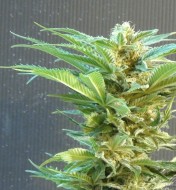
The plant’s appearance changes as it develops. Early leaves may be broader and Indica-like, while narrower, Sativa-style leaves become visible later. Outdoors, its sativa characteristics can become more apparent as the days grow shorter.
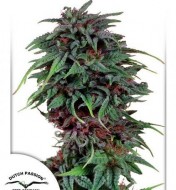
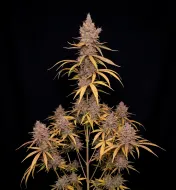
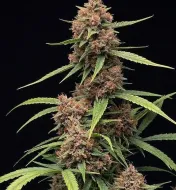
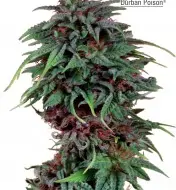
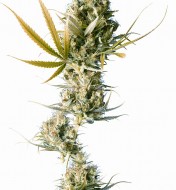
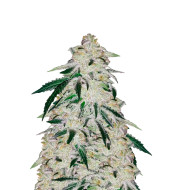
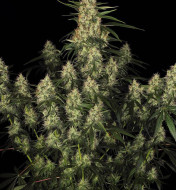
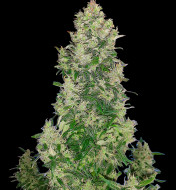
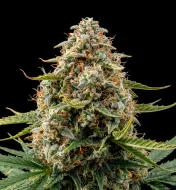
The flower clusters have the long, slender form associated with sativas, yet the buds are very dense for the type. Their calyx-to-leaf ratio is very high, and the small sugar leaves are covered in resin. Large resin glands add to the appearance of the elongated flowers.
Durban Poison has been adapted to the windy and rainy conditions of Northern Europe and is considered suitable for outdoor growing even at extreme northern and southern latitudes. It is also described as preferring slightly milder outdoor climates. The broader Dutch Outdoor family, which includes this strain, is described as performing well in cool Northern European climates and as resistant to mold and disease.
In a German outdoor diary of Durban Poison Regular, The_outdoor_guy recorded a height of 7 ft for the second of two plants. Earlier in the grow, a plant appeared to recover quickly after hail damaged a young shoot.
After rainy weather, the author reported bud rot on several flower clusters of the first plant and on one cluster of the second, while noting that the precise cause was unknown. Concerns about the rot and forecast poor weather influenced the harvest of the main flowers, which took place on 25 September for one plant and 1 October for the other.
The diary recorded 10 oz of dry buds from the two plants, around 7 oz per plant, and also noted that 10 oz had to be discarded. The author described the buds as somewhat airy, linking their density to the early harvest.
Durban Poison’s aroma brings together aniseed, licorice, lemon and cloves. The flavor carries those notes too: lemon adds a citrus element alongside the anise and spice, while floral notes are also present. The taste has a spicy, hazy character.
Before drying and curing were complete, The_outdoor_guy described the flowers in the German diary as having an aniseed scent with a little fruitiness. The smell was not very intense.
The flowers are described as high in THC, with strong, uplifting and energizing effects that can be relatively long-lasting. This profile is associated with daytime activity and creative tasks. An initial lift in energy may be followed by a more sedative effect when larger amounts are involved.
In forum accounts of Dutch Passion Durban Poison where the seed version was not specified, Boogieman described an aniseed smell and an earthy, old-school flavor. He reported a strong, soaring head high that became more balanced after about 45 minutes. Another contributor, Ktaadn, found their sample weak in effect, even compared with leaves, and disliked its hay and black-licorice taste.
A Sativanalysis certificate associated with Durban Poison examined a dry-flower sample named Durban PC. The analysis, published on 15 September 2020, recorded 12.29% Δ9-THC, 2.65% CBD and 0.52% CBG in that sample. The certificate did not identify the seed version or batch.
The same sample contained 0.31% CBC, 0.05% THCV and 0.14% CBN, while CBDV and Δ8-THC were each below 0.01%. Its accompanying terpene graphic listed beta-myrcene, alpha-pinene, beta-pinene, limonene and beta-caryophyllene.
Durban Poison Regular combines South African heritage and sativa dominance with dense, resinous flowers and a spicy, floral flavor. Its energizing profile and substantial yield potential add to its appeal. If you are looking for regular seeds of a distinctive photoperiod strain, choose Durban Poison Regular from Dutch Passion.